


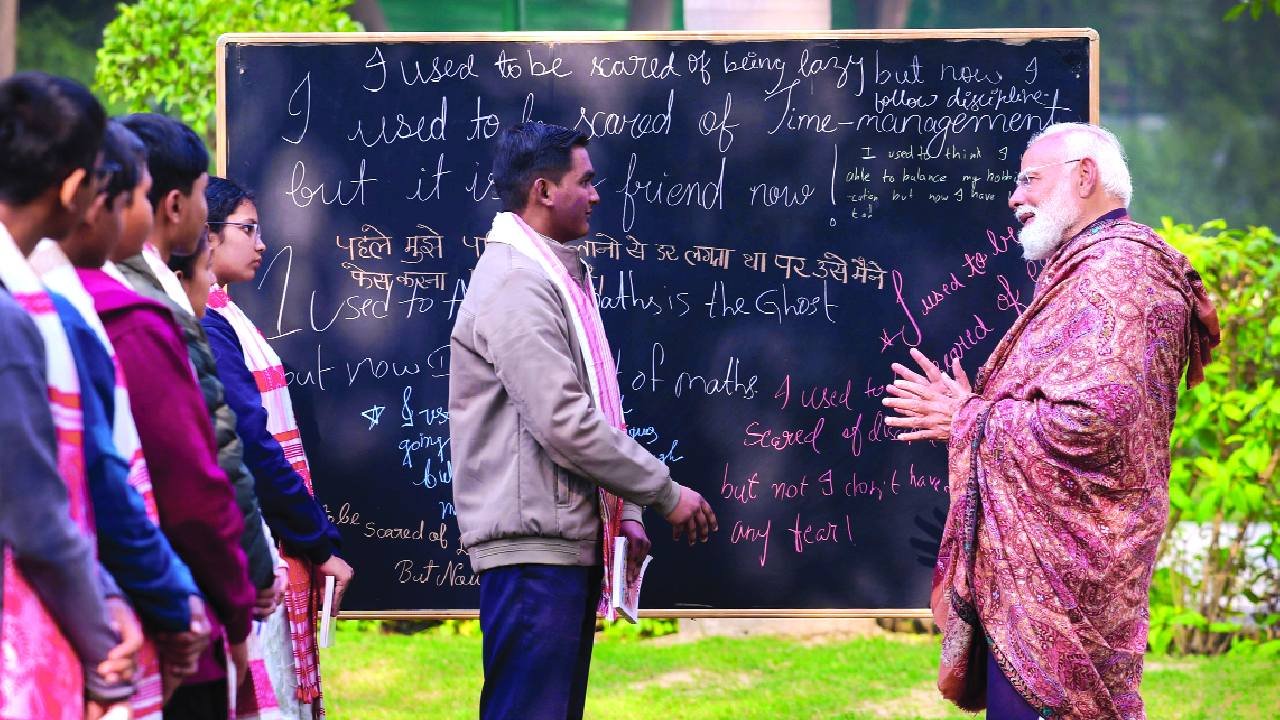
Prime Minister Narendra assumed the role of a teacher to millions of students on Friday during which he is believed to have de-stressed himself after an intense Parliament session and simultaneously help calm the nerves of lakhs of students appearing for their Board examinations during the next two across the country.
In his interaction with students during the ninth edition of Pariksha Pe Charcha (PPC), a student from Gujarat asked that while parents worry for them and teachers support them, the issue arises when teachers suggest one study pattern, parents insist on another, and students follow a different trend, leaving them confused about which pattern is correct.
The PM remarked that this continues throughout life, noting that even as PM people advise him differently. He highlighted that just as siblings at home have different eating patterns — some starting with vegetables, some with dal, some mixing everything together — everyone has their own way. He emphasised that enjoyment comes from following one’s own pattern.
Prime Minister acknowledged the concern of several students on simultaneous preparations for Board as well as competitive exams, Modi compared it to playing cricket and football at the same time, and emphasised that priority must be given to the Class 12 boards. He remarked that if students thoroughly absorb their syllabus, competitive exams will become a by-product without requiring separate effort. The PM advised a simple method for time management: writing tasks in a diary before sleeping, tallying them the next day, and analysing why some tasks were left incomplete.
Modi explained that some prefer studying at night, others early in the morning, and each has their own rhythm. He cautioned against dishonesty, mentioning how some students tell their mothers they will study in the morning but then avoid it. He stressed that students must trust their own pattern, listen carefully to suggestions, and add improvements only through personal experience, not merely because someone says so.
He highlighted that when he began Pariksha Pe Charcha there was one pattern, but over time he improved it, even conducting sessions in different States, changing the format while retaining the core. Students noted that the Prime Minister’s nature was very friendly and that he mingled easily with them, explaining that everyone should listen to different patterns, take good qualities from each, focus on their own, and gradually strengthen it.
Giving tuitions on historical perspective, Modi highlighted that Mahatma Gandhi returned from Africa in 1915 and led the freedom struggle until 1947, and that sacrifices by leaders like Bhagat Singh inspired generations to fight for independence. He stressed that if such a monumental freedom could be achieved, then through collective effort a developed India can certainly be realized.
Modi illustrated with examples: without life skills, one may struggle even in daily tasks like cooking or buying a ticket at a railway station. He emphasized that life skills must be fully achieved, including discipline, confidence, and adaptability. On professional skills, he explained that doctors must constantly update their skills, as books alone cannot make one a heart specialist-real skill comes from working with patients. Similarly, lawyers must practice under seniors to develop courtroom skills beyond knowing constitutional provisions.
PM underscored that professional skills require continuous learning and adaptation to new technologies, even at age 40, as advancements in medicine and other fields demand constant updating. He underlined that education and skill are twin siblings, inseparable, and that skill is indispensable in life.
Interacting with the Prime Minister, another student who asked that often students cannot match the speed of school or teachers, and in trying to cover what is missed, they lose track of further chapters and fall behind. Modi highlighted that teachers should keep their speed just one step ahead of the students, not too much, with the goal being within reach but not easily achievable.
A Student from Sikkim shared that she had composed a song in three languages-Hindi, Nepali, and Bengali-titled ‘Hamara Bharat Bhumi’, a patriotic song.

