


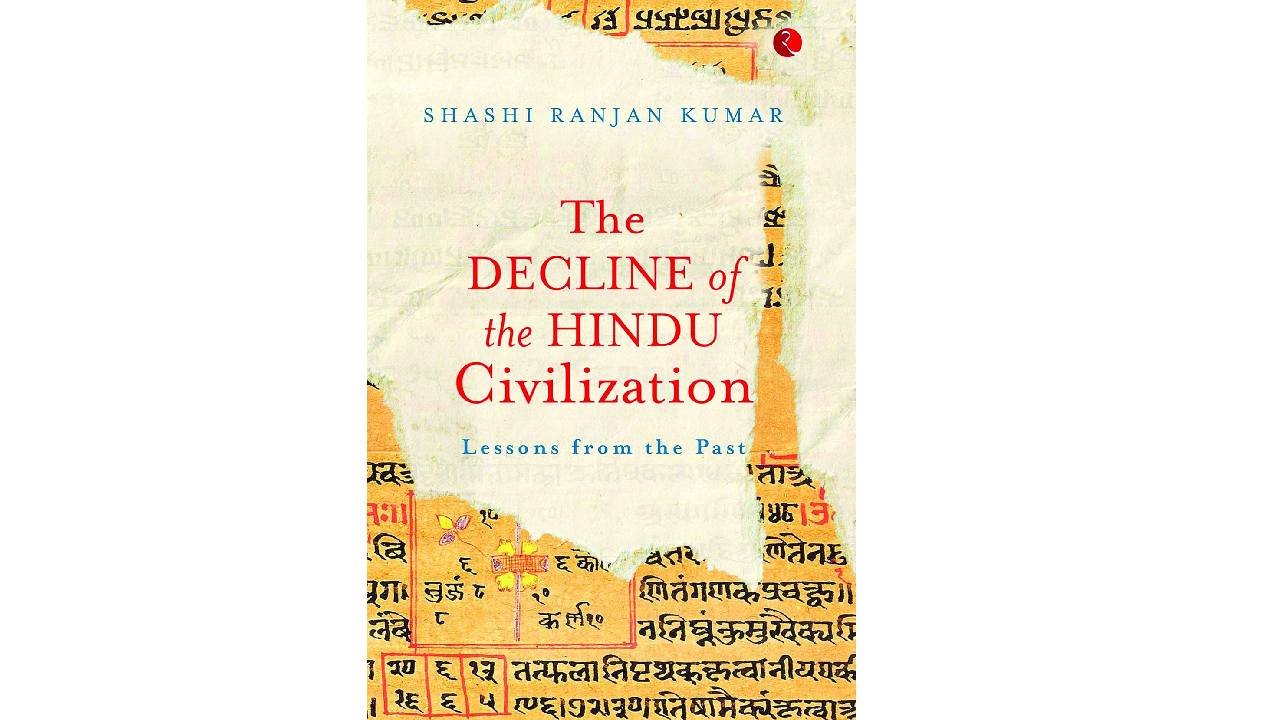
As the past is remembered now and the future is imagined now, history-writing is basically about the way historians interact with the past, the sources they use, the facts they choose to highlight, the instances they paper over, the ideological markers they are committed to, and their vantage point. Shashi Ranjan Kumar’s The Decline of the Hindu Civilization: Lessons from the Past (RUPA) takes a hard look at the chequered past of India partly because there is ‘no deliverance from the past’ but mainly to understand how and why the magnificent Hindu Civilization underwent decline, what went wrong, and the lessons it holds for the future.
An Arguer, a Debunker
Unencumbered by any ideological straightjacket, Kumar is an arguer and a debunker of ideas which have held sway for long. Taking recourse to primary sources and quoting from secondary sources, he deploys a comparative approach to put his arguments across.
First, he seeks to debunk the widely held argument that there was no Hinduism before the 19th century and that Hindu was merely an ethno-geographic idea. He argues that if Hindu were merely an ethno-geographic expression, native converts to Islam should have been called Hindus or Hindu Muslims, but that has certainly not been the case; that various sects, doctrines, and customs practised across the country had many overlapping commonalities; and that the religious sense of being a Hindu was precipitated by the arrival of Islam. Islam — because it represented an alien worldview which was backed by the coercive apparatus of the state — contributed to the identity articulation of what came to be called Hindus. The author also counters the long-held view that India as a nation is the invention of the nationalist imagination of the 19th century and emphasises the point that the idea of India is actually a reinvention of the old idea of Bharatvarsha. Another long-held view — that only Kshatriyas were recruited into the military – is challenged by him. He makes an interesting point that anyone who usurped political power — irrespective of his Varna — had to be granted political legitimacy — Nandas, Mauryas, Palas, Yadavas being a few of the numerous cases. Kumar takes denialists to task for denying the civilisational accomplishments of the Hindus. In fact, part one of the book deals with their achievements in education, science, mathematics, health sciences, aesthetics and the art of love, poetics and dramatics, realpolitik, and most of all, the spread of cultural and civilisational influences across much of Asia. But obviously, the civilisation ran into severe headwinds at some point in time to lose its vitality and resilience. How did it happen? It constitutes the core of the book.
What Went Wrong?
Before discussing the reasons for the decline, Kumar makes a significant point that no country of the size of India has been under foreign domination for so long. He does not accord centrality to the inequities and pathologies of the caste system and the lack of political unity to explain the decline. He rummages through the past to dig out more fundamental factors in order to explain the decline. According to him, Indian defeats were a civilisational failure. A civilisation that was open, permeable, energetic, and receptive shut itself. The Hindus had previously borrowed liberally from the Persians and the Greeks, but after barbarian invasions, they ceased to believe that any foreign country had any civilisation. Al-Biruni in Kitab al-Hind pointedly refers to the impervious insularity of the Hindu mind. This insularity, according to the author, meant that the Koran remained untranslated in India for more than a thousand years. If the Hindus had read it, they would have known that the iconoclastic zeal of the invaders had a theological basis. Kumar also attributes the decline to the military gap between the Hindus and the invaders. The continuation of obsolete methods and tactics of warfare would lead to disastrous military consequences. The use of firearms dealt a severe blow to the use of elephants as a command vehicle. The technological gap was worsened by the lack of good-quality horses in India. The malaise, as the author argues, goes much deeper. Raw valour without strategic acumen and foresight would not take an army far. ‘For Rajputs, war was almost a form of sport with its own rules of play, but for the Turks, it was about life and death.’ This singular inability to measure the enemy would prove detrimental. This inability owed itself to the fact that Hindus were disinterested in the world. As traders and preachers, Indians would travel outside but not as explorers. So we have no Marco Polo and no Ibn Battuta. On the other hand, the world was deeply interested in India. This incomprehension of external threat from the North West makes Romila Thapar wonder why the Indian rulers did not build something like the Great Wall of China to defend the North Western passes. Perhaps there was a basic lack of consciousness of the need for defence.
The author almost laments that India never produced a realist thinker other than Kautilya and, sadly, his lessons were quickly forgotten. He refers to how Bana condemns the science of Kautilya as immoral in Kadambari. And as late as the 14th century, Pandit Chandeshvara’s Rajnitiratnakara still speaks of the efficacy of war chariots which had long become defunct. But his most interesting argument is that, endowed with fertile land and abundant water engendering an easy life, expansion was not needed. He seems to suggest that this led to smugness and neglect of defence. On the other hand, the invaders had the first-mover advantage. Here he quotes Kaushik Roy to make a significant point, “No agrarian society was able to stop nomadic, mounted archers.” The book is likely to invite a close look and inevitable criticisms on a few counts. First, he treats all Indic religio-cultural traditions, including Buddhism and Jainism, as part of the overarching Hindu civilization. Second, his laudatory account of the past almost verges on the idea of a golden age — an idea which should best be taken with a pinch, if not a fistful, of salt. Third, his ambivalence towards the Muslim question veers between monotheism-induced certitudes and bigotry on the one hand, and the gradual indigenisation of the Muslim invaders in India on the other. At one point, he writes that the Mughals were no less inward-looking, but he does not explain how they became inward-looking after having successfully invaded and conquered India.
Why It Ought to Be Read?
It should be read because it challenges long-held views with evidence and arguments and opens the debate for further argumentation and contestation. The book distinguishes itself in terms of analysing five key wars and why and how the invaders would get the better of the Indians. Further, the book contextualises India in relation to the contemporary world in general and Asia in particular to understand the dynamics of cross-cultural influences and inevitable confrontation. But most importantly, it seeks to grapple with the past not to avenge the past but to take lessons from the past.

