


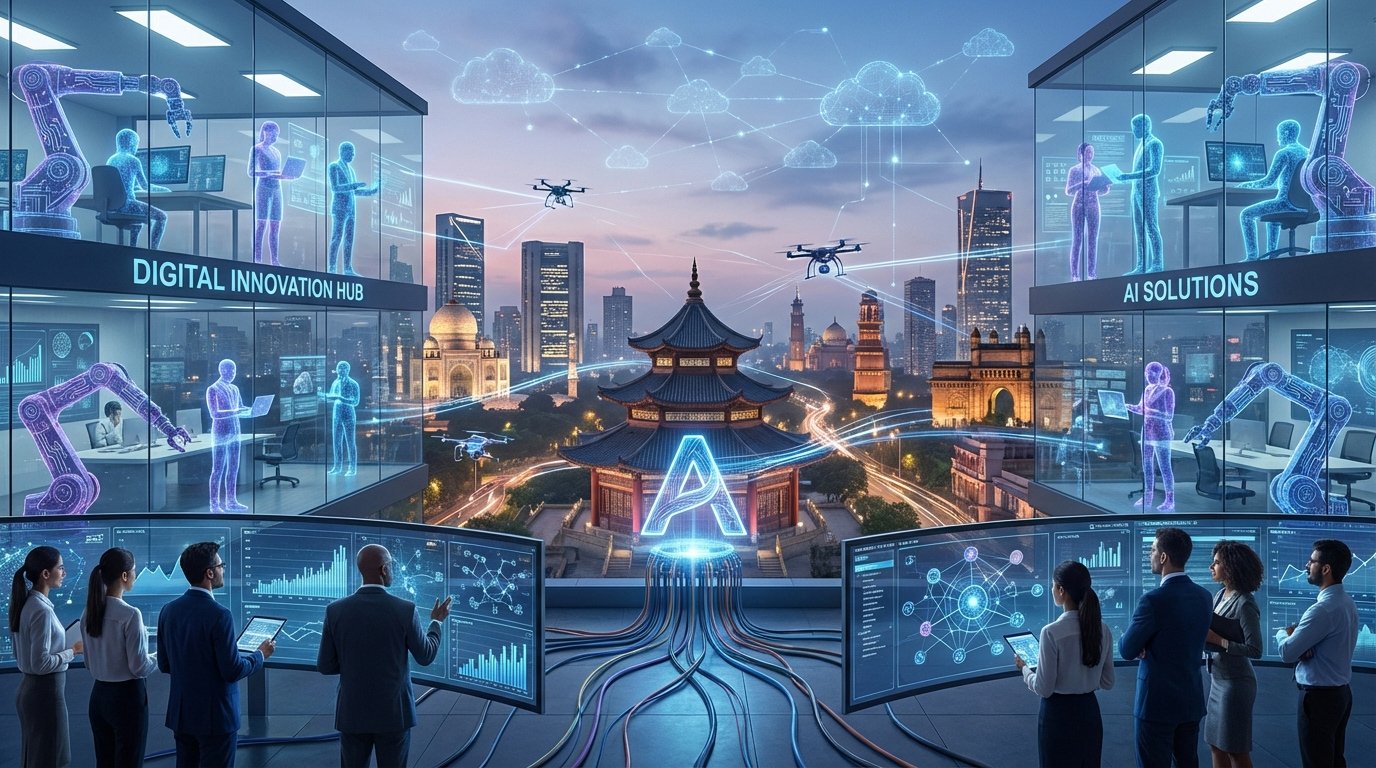
India’s services sector is in the middle of its biggest transformation since the BPO boom. But unlike that wave, which took a decade to mature this one is moving in years, not decades. The traditional agency model: hire professionals, bill by hour, scale by adding people has been reshaped by AI. The first wave of tool adoption is complete. The question now is what comes next.
AI agents have redefined how work gets executed. They are goal-driven systems capable of performing multi-step tasks. The ad agency that creates stunning videos without the time and expense of physical shoots or a legal firm who can draft contract documents in hours as opposed to weeks. In practical terms, this means that what once required a 20-member agency team is now being orchestrated by a smaller team supported by specialized AI agents handling defined layers of work. Instead of scaling through hiring, organizations are scaling through workflow architecture.
But the next frontier is different. It’s not about AI agents doing tasks, it’s about autonomous agent systems that design their own workflows, coordinate with each other, and improve without human intervention. We are already seeing early versions of marketing agencies where agents don’t just execute campaigns but analyse performance data, hypothesize improvements, and optimize spending all while the human team focuses on brand strategy and client relationships.
Our services sector has been process-driven and structured. We built global credibility in finance operations, compliance management, IT services, content production, and back-office execution precisely because these domains were workflow-intensive. That was our advantage when workflows required human execution. But workflow-intensity is now the very characteristic that makes work most susceptible to agent automation. The domains we mastered are the first targets. Our historical strength has become our immediate vulnerability unless we transform it into architectural advantage.
This transformation extends beyond finance and compliance. India’s creative industries cinema, advertising, gaming, publishing, and digital media are deeply workflow-driven ecosystems. Script development, narrative iteration, budgeting, scheduling and audience analysis can increasingly be architected into intelligent systems. In a country that produces some of the world’s highest volumes of filmed and digital content, AI-native creative agencies could emerge as a new export category where storytelling remains human-led, but execution is system-accelerated.
For India to lead the next phase, three strategic priorities must be addressed.
First, move from deploying agents to building agent platforms. Indian firms shouldn’t just use AI agents they should create vertical-specific agent systems that global clients license.
Second, architect for autonomous multi-agent collaboration. The future isn’t individual AI assistants, it’s coordinated agent swarms. Indian firms have decades of experience orchestrating distributed teams that organizational knowledge translates directly to orchestrating agent swarms.
Third establish regulatory and ethical leadership; India could set the global standard. As agent-driven work scales, questions of liability, data ownership, and algorithmic accountability will define competitive advantage. More importantly: whoever sets the standards shapes the market. If India doesn’t lead here, it will follow rules written elsewhere.
There are broader economic implications. India’s services exports have historically depended on cost arbitrage. That model is ending now, not in ten years. The question is whether India captures value in the next model or gets marginalized by it. The next decade will separate nations into two categories: those that export AI-powered services and those that export the AI systems themselves.
Three phases define this transformation. The phase one where agencies adopt AI tools, this is largely complete. The phase two is happening now where agencies architect AI-native workflows. The phase three where agencies become agent platform companies, licensing their specialized systems to global markets this is where India must position itself.
Nations that master this architectural layer will define the next phase of the global services economy. India has the talent, the process maturity, and the entrepreneurial momentum. But the window is narrow. While Indian agencies optimize current operations, competitors in Singapore, UAE, and Israel are building the platforms that could commoditize that very optimization. The question isn’t whether India will use AI agents. The question is whether India will design the systems the world depends on or depend on systems designed elsewhere.

