


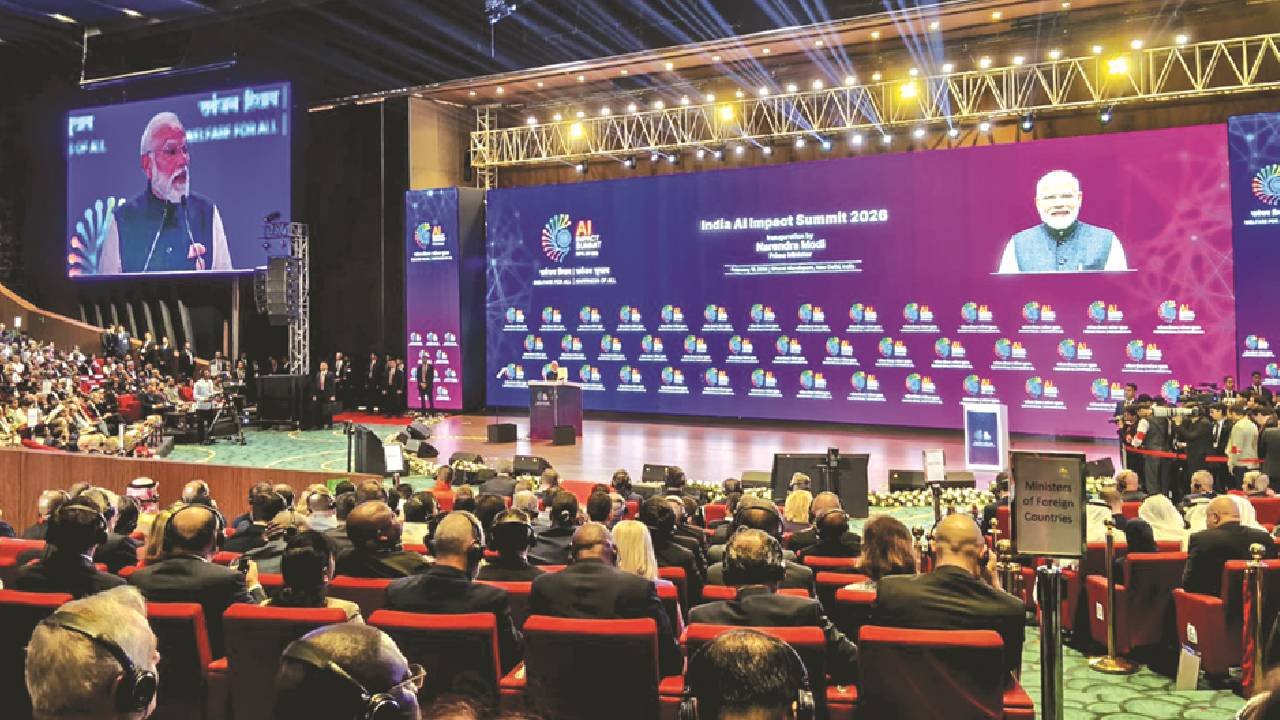
The emergence of Artificial Intelligence (AI) as the defining technology of the 21st century has reshaped global power equations. Control over data, computing, and algorithms is rapidly becoming as consequential as control over energy or finance. Against this backdrop, the India led AI Impact Summit scheduled at New Delhi from 16-20 February 2026 is about to make a decisive shift in ways the AI will be conceptualised, governed, and deployed.
The unique feature of this summit is rooted in inclusion, and development outcomes rather than scale, dominance, or monopoly. India’s intervention comes at a critical moment when the world enters in “AI Techade,” where prevailing AI models remain concentrated in a handful of countries and corporations. The Indian proposition aims to advance a model of democratic, frugal, and sovereign AI, explicitly designed for the realities of the Global South.
Drawing on its experience with Digital Public Infrastructure (DPI), India has positioned itself as both a laboratory and a bridge for cutting-edge technology with large, diverse, and suitable for resource constrained societies.India has opted for a layered and strategic approach that prioritises autonomy, efficiency, and scalability. This architecture spans five interlinked layers: applications, models, chips, infrastructure, and energy.
Together, they form a vertically integrated ecosystem capable of sustaining national AI capabilities without excessive dependence on external vendors or geopolitically vulnerable supply chains and growing trends for weaponisation of technology. India’s focus is on task-specific and medium-scale modelsoptimised for population scale governance models to facilitare service delivery, and productivity gains through aligning the model designs with real-world use casessuch as agriculture advisories, welfare targeting, health diagnostics, and education delivery.
This idea is reinforced by investments such as the 10,000-GPU national compute grid and initiatives like BharatGen, which would help democratise access to AI resources for startups, researchers, and public institutions. The underlying principle is “diffusion first”: AI must be widely deployed and locally usable, rather than remaining confined to elite research labs or corporate silos.
By reducing training costs, optimising inference efficiency, and emphasising return on investment, India offers a credible alternative to capital-intensive AI models that are inaccessible to most developing countries.This approach has already yielded measurable outcomes. According to global benchmarks, India ranks among the top 3 countries in AI talent availability and preparedness. More importantly, it has demonstrated the ability to deploy AI at population scale enabling India to function as a systems integrator, capable of aligning AI with governance structures and developmental priorities.
The political framing of India’s AI model was articulated forcefully by senior leadership during global engagements. The message was unambiguous: India does not see itself as a follower in the AI race, but as a producer, tester, and
One of the most consequential pillars of India’s AI ecosystem is its work on language technologies. With 22 official languages and hundreds of dialects, India deals with a huge linguistic diversity. The Bhashini initiative, launched under the National Language Translation Mission, addresses this challenge by providing open, interoperable AI services for speech, translation, and voice interfaces.Bhashini operates as a public digital good.
Its open APIs enable Governments, startups, and civil society actors to build services in local languages at affordable costs. The platform relies on participatory data creation through initiatives such as crowdsourced language contributions, ensuring that AI systems reflect local idioms and cultural nuance rather than imported linguistic norms. This linguistic capability is not merely technical; it is political. Language access determines who can participate in the digital economy, access public services, and exercise civic rights. By embedding linguistic inclusion into its AI stack, India advances the idea of digital citizenship as a universal entitlement.Strategic convergence with Africa
India’s AI experience holds particular relevance for Africa, a continent defined by demographic dividend, linguistic diversity, and developmental urgency. With over 2,000 languages and a rapidly growing youth population, Africa faces challenges strikingly similar to those India has navigated over the past two decades. The Indian AI model therefore offers a natural foundation for South-South cooperation.
Low-resource language training techniques developed for lesser spoken and geographically concentrated Indian languages can be directly adapted to African contexts, enabling local languages to become functional interfaces for governance, education, and commerce. This alignment supports the objectives of Agenda 2063 and its Second Ten-Year Implementation Plan (2024-2033), which identify digital transformation and AI as strategic enablers of inclusive growth.
Beyond language, India’s DPI-driven AI solutions provide ready-to-deploy templates for health systems, financial inclusion, agricultural extension, and logistics optimisation. Rather than importing proprietary platforms, African countries can co-develop sovereign AI capabilities that retain control over data while benefiting from shared architectures and open standards.
AI as an economic multiplier under South-South cooperation The economic implications of this partnership are substantial. AI adoption has the potential to significantly boost productivity, reduce transaction costs, and integrate fragmented markets. Applied strategically, AI can help operationalise the African Continental Free Trade Area (AfCFTA) and Regional Customs Unions like East African Community (EAC), Economic Community of West African States (ECOWAS) and South African Customs Union (SACU) by streamlining customs procedures, optimising supply chains, and reducing logistics inefficiencies.
India’s experience in fintech-enabled credit assessment, for example, illustrates how AI can unlock financing for small and medium enterprises the backbone of African economies. Similarly, AI-driven manufacturing optimization can support Africa’s transition from raw material exports to higher-value industrial activities, reinforcing economic resilience.
A persistent concern surrounding AI is its impact on employment. India’s model offers a counter-narrative. Rather than emphasising labor replacement, it prioritises skill upgrading and augmentation. AI tools are deployed to enhance worker productivity, support
decision-making, and expand service coverage. For Africa, where millions of young people enter the job market annually, this distinction is critical. AI-enabled vocational training delivered in local languages can accelerate skill acquisition and align workforce capabilities with emerging sectors such as digital services, green manufacturing, and logistics. In this framework, AI becomes an enabler of decent employment rather than a source of displacement.
A New Template for Global Technology Governance
The broader significance of the AI Impact Summit lies in its contribution to global AI governance. By foregrounding impact, accessibility, and safety, India has galvanised a collective conversation among developing countries about data sovereignty, algorithmic bias, and ethical deployment. The strong participation of Governments, multilateral institutions, and industry leaders’ signals growing momentum for a more inclusive techno-legal framework.
To sum up; India-led AI Impact Summit marks a pivotal moment in the evolution of global AI. By advancing a sovereign, frugal, and inclusive model, India has expanded the realm of possibility for the Global South. Its AI stack demonstrates that technological leadership need not be synonymous with exclusion, and that innovation can be aligned with equity, autonomy, and shared prosperity.
The deepening convergence between India and Africa illustrates how South-South cooperation can shape the next phase of the digital revolution. As AI continues to redefine economies and societies, the principles articulated through this partnership; openness, sovereignty, and human-centric design, may well determine whether AI becomes a bridge to collective advancement or a barrier reinforcing old divides. Prime Minister Narendra Modi addressing the gathering during the India AI Impact Summit 2026 in New Delhi.
Distinct Features of India led Initiatives in AI
The India-led AI Impact Summit reframed AI as a developmental and geopolitical instrument rather than a purely commercial technology. India’s Sovereign AI model emphasizes autonomy, frugality, and population-scale deployment through a five-layer architecture.
Its distinct features are medium-scale, task-specific AI models which offer high impact without the costs and dependencies on trillion-parameter systems. Language platforms such as Bhashini embed linguistic inclusion into AI, enabling digital participation across diverse societies.
India’s AI experience aligns closely with Africa’s development priorities under Agenda 2063 and its Second Ten-Year Plan. India is positioning AI as a multiplier for growth, trade integration, SME financing, and youth employment through skill upgrading.
Through this initiative India is open to strengthen South-South Cooperationcapable to addressing the needs of African nations by creating customized template for equitable, sovereign, and human-centric Africa led technology governance.

