


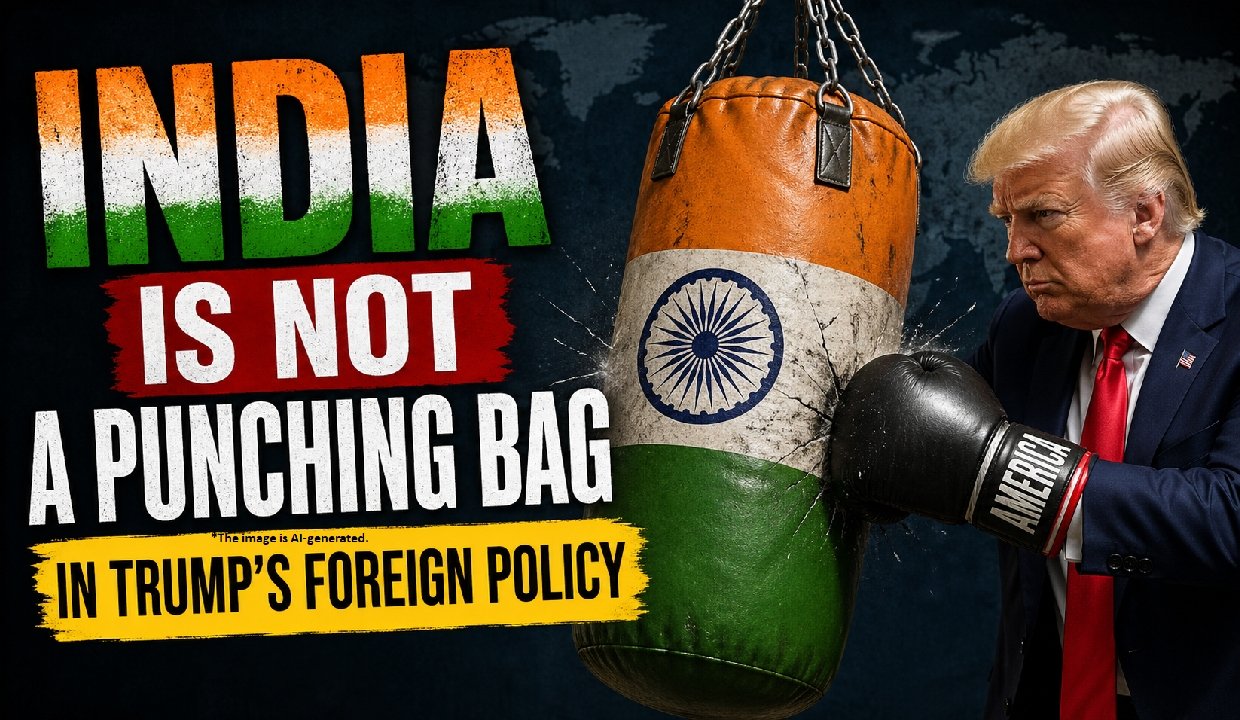
A president can insult a foreign nation in many ways. The crudest may be the easiest, a tap on a repost button that turns a slur into state speech.
Donald Trump’s decision to amplify a Truth Social post calling India and China “hellholes” and branding Indian immigrants “gangsters with laptops” was not stray online noise. It was a public act by the White House. Once that language moved through a presidential account, it stopped being a hot take and became a message with diplomatic weight.
That is why this episode matters. It was not plainspoken honesty. It was reckless statecraft, grievance dressed up as candor, and a needless humiliation of a country Washington still describes as a strategic partner.
Presidents don’t stumble into language like this. They choose it, or they choose not to stop it.
That distinction matters because the office matters. A repost from a private citizen is chatter. A repost from the president of the United States is endorsement, even when aides later pretend it was only commentary or mood.
Why words from the White House carry global force
Every embassy reads presidential language as a signal. So do foreign ministries, investors, and allied governments. They may discount bluster, but they don’t ignore it. That is because presidents shape more than headlines. Their words affect trust, raise doubts, and sharpen existing tensions. When the White House names a partner country and attaches contempt to it, the insult doesn’t stay online. It enters the daily work of diplomacy.
Trump has long treated public language as spectacle. He often speaks as if outrage itself proves strength. Yet a presidency is not a cable segment, and it is not a comment thread. It is an office with military power, treaty obligations, and global reach. Impulse from that office carries a cost.
A pattern of praise in private, insult in public
The contradiction is hard to miss. Trump has often spoken of India as an important partner. He has praised Prime Minister Narendra Modi, courted Indian American voters, and spoken warmly about ties between the two states.
Then came a repost that smeared India in language fit for a crank pamphlet. That gap matters because it reveals the real method. Praise is handed out when useful. Humiliation appears when grievance politics needs a target.
This is not consistency. It is performance. And for a partner country, performance like this is a warning.
Calling India a ‘hellhole’ insults a nation, not a policy
A Government policy can be criticized. Trade rules can be attacked. Visa systems, border law, pollution, corruption, and religious tension can all be debated in plain terms. None of that requires contempt for an entire country.
Calling India a “hellhole” is different. It is not a policy argument. It is a sweeping insult aimed at a nation of more than 1.4 billion people and one of the oldest continuous civilisations on earth.
India is bigger than any American political talking point
India is not a prop in an American fight over citizenship law. It is the world’s largest democracy, a nuclear power, a major economy, and a society with immense internal variety. Its elections move hundreds of millions of voters. Its courts, parties, states, and press create a rough and noisy public life that few countries could manage at that scale.
Its civilisational record is also older than the American republic by millennia. Indian thinkers helped shape mathematics, philosophy, linguistics, astronomy, and medicine long before the United States existed. The concept of zero, major schools of logic, and influential medical traditions all emerged from that long history.
None of this places India above criticism. No country is. But criticism is one thing; a civilisational slur is another.
India can absorb an insult from Washington. It has the size, state capacity, and strategic value to move on if it chooses. But endurance should not be confused with indifference.
National dignity is not vanity. It is part of how states relate to one another. When a US president degrades India in public, the injury falls on more than officials in New Delhi. It touches the public, the diaspora, and the idea that major democracies owe each other basic respect. Silence in such moments also carries meaning. If a country accepts humiliation because the relationship is useful, it teaches others how cheaply that respect can be bought.
The repost did not stop at India. It also smeared Indian immigrants as “gangsters with laptops” with no loyalty to America. That line was ugly on its face, and it also collapsed under the weight of simple fact.
Indian Americans are, by most common measures, among the most educated and highest-earning groups in the United States. They work across medicine, engineering, finance, research, academia, and small business. They are not a fringe presence. They are woven into the country’s professional and civic life. The evidence is visible without romanticising it. Indian Americans lead major firms, including Google, Microsoft, IBM, and Adobe. Many more work far from public view, in hospitals, labs, universities, and infrastructure projects that keep the country running.
Their impact is not only corporate. Indian American physicians care for patients across the country, often in regions that struggle to attract doctors. Engineers design systems that millions use every day. Researchers contribute to universities and private labs. Entrepreneurs start companies, hire workers, and pay taxes. If that is what a “hellhole” produces, the United States has profited from it for years.
That does not make Indian immigrants immune from criticism as individuals. No group is above normal scrutiny. But group slander is not scrutiny. It is prejudice with a political accent.
A hard argument about birthright citizenship is still a domestic legal argument. People can disagree on that issue, sometimes sharply, without smearing a nationality.
The moment the rhetoric shifts to naming India and depicting Indians as criminals by type, the debate changes. It is no longer about law. It is about ethnic suspicion and national contempt. That matters because language like this invites broad blame. It asks the public to see a people through caricature, not conduct. It also sends a message to citizens of Indian origin that their success will not protect them from suspicion when politics wants a scapegoat. Trump’s defenders will say this was only about domestic politics. They will argue that the real target was birthright citizenship, or the broader fight over immigration and national identity. That defence fails on contact with the facts.
When a sitting US president names a sovereign nation and degrades it in public, the issue crosses borders at once. The presidency is not a private venue. It is the most visible state office in the world.
The international effect does not depend on intent. It comes from the office itself. Foreign governments do not have the luxury of treating a presidential insult as a random mood. They must read it as a clue to priorities, temperament, and limits.
That is why this episode cannot be filed away as campaign-style rough talk. India is a central player in the Indo-Pacific, a defence partner, a trade counterpart, and a country Washington needs for long-term balance in Asia. Public contempt weakens the trust that strategy requires. The world watches these moments closely. So does India. The question is not whether New Delhi can survive a slight. It can. The real question is what the United States reveals about itself when its president treats a major partner as disposable material in a culture-war script.
Respect between states does not require flattery. India and the United States have real disagreements on trade, visas, human rights, Russia, and market access. Serious governments handle those disputes through policy, pressure, negotiation, and plain speech.
Humiliation is not plain speech. It is a substitute for argument. It turns diplomacy into theater and invites the other side to absorb the insult for the sake of convenience.
India is too large, too important, and too self-respecting for that role. A mature partnership can survive disagreement. It cannot thrive on public degradation. In the end, Trump’s repost revealed arrogance, not strength. It took an ugly insult and gave it presidential force, then aimed it at a country the United States still needs as a partner.
The damage was not only to India’s dignity. It was also to American credibility. A president who mistakes insult for leadership lowers the value of his own office and weakens the country’s claim to seriousness abroad. India does not need validation from a US president. But the United States harms itself when its leader cannot tell the difference between candor and contempt, or between a political prop and a civilisation.

