


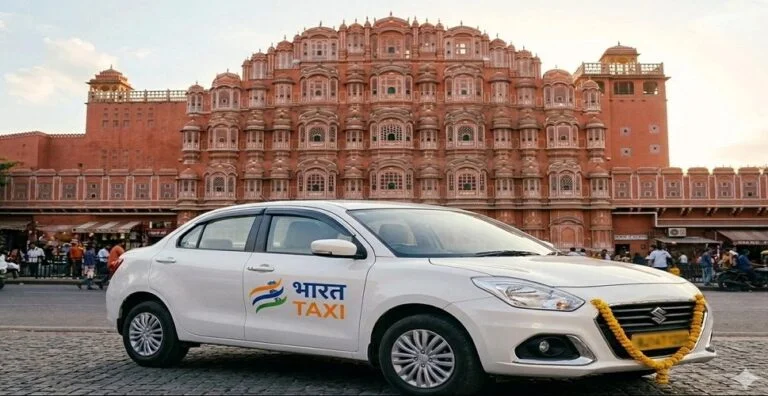
Bharat Taxi Rajasthan: Rajasthan Chief Minister Bhajanlal Sharma officially launched the ‘Bharat Taxi Rajasthan’ service on Saturday from the Bhagwat Singh Mehta Auditorium at OTS, Jaipur. Union Minister of State for Cooperation Murlidhar Mohol, Rajasthan’s Minister of State for Cooperation (Independent Charge) Gautam Dak, and other public representatives were present at the event. Bharat Taxi is being touted as the country’s largest cooperative-based mobility platform. It is operated by Sahakar Taxi Co-operative Limited. Based on a multi-state cooperative society model, the initiative aims to provide affordable travel for passengers and better income for drivers.
What are the benefits for passengers?
It is claimed that rides booked through Bharat Taxi Rajasthan will be 10 to 15 percent cheaper than those offered by existing private cab services. For instance, a passenger could save up to ₹25 on an 11-kilometer trip. A key feature is that ‘surge pricing’ will not apply to this platform; fares will not increase during peak hours or periods of high demand. Passengers will be able to book bike, auto, and taxi services through a single mobile app.
Drivers become ‘Saarthis’ (Charioteers) and Co-owners
A unique aspect of this platform is that drivers are accorded the status of ‘Saarthis’ (charioteers) and co-owners, rather than just partners. Unlike private cab companies that charge hefty commissions, this model focuses on increasing drivers’ earnings. According to a driver associated with the platform, his income has risen by approximately 20 percent over the last two months, and he is securing 10 to 12 rides daily. Additionally, every driver will be provided with accident insurance coverage of ₹5 lakh.
Cooperative societies to be formed in every village
The Chief Minister stated that efforts would be made to establish cooperative societies in every village across the state. He noted that Rajasthan’s current milk production stands at 4.6 million tonnes (46 lakh tonnes). The target is to increase this to 5.5 million tonnes (55 lakh tonnes) by next year and to 6.5 million tonnes (65 lakh tonnes) within the next two years.

