


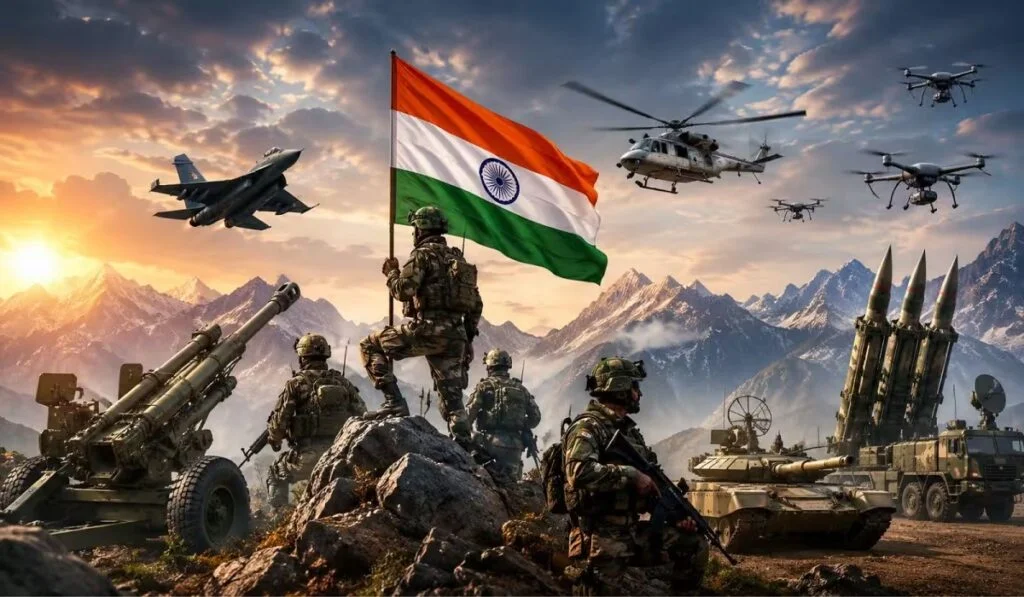
27th Anniversary of the Kargil War: This year, the entire nation is celebrating the 26th Kargil Vijay Diwas. This day shines as a beacon of pride in India’s history. It symbolizes the glorious victory of 1999, when our soldiers—braving snow-capped peaks and relentless enemy shelling—recaptured the Kargil heights with unparalleled courage and unwavering resolve. On July 26, the Tricolour fluttered proudly once again over the rugged hills of Ladakh, standing as a symbol of sacrifice, valour, and steadfast national spirit. The Kargil War proved to be a pivotal moment in India’s defence journey. It highlighted the need for better synergy, rapid modernization, and greater self-reliance. Over the past few years, India has undertaken significant reforms to strengthen its defence apparatus and develop indigenous capabilities. Today, these efforts are shaping a robust, more capable, and rapidly self-reliant military. Initiatives such as the establishment of the Department of Military Affairs (DMA), the creation of the post of Chief of Defence Staff (CDS), Foreign Direct Investment (FDI) in the defence sector, and the consistent increase in the defence budget reflect some of the key reforms and measures implemented in recent years.
Establishment of the Department of Military Affairs
The Department of Military Affairs (DMA) was established as part of reforms in higher defence management. This department functions under the Chief of Defence Staff (CDS), who also serves as its Secretary. The objective of the DMA is to promote jointness among the Army, Navy, and Air Force, and to ensure better coordination in defence-related policies, planning, resource management, and procedures. The creation of the post of Chief of Defence Staff (CDS) is among the most significant reforms in higher defence management. The CDS serves as the principal military advisor to the government and plays a crucial role in strengthening jointness, coordination, and integrated military planning among the three armed forces. General Bipin Rawat became India’s first CDS in 2020; currently, General Anil Chauhan holds this responsibility. The defence industry has been opened up for extensive private sector participation. To encourage investment in defense manufacturing, the Foreign Direct Investment (FDI) limit under the automatic route has been raised to 74 percent. Additionally, FDI of up to 100 percent is permitted via the government route for projects involving modern technology.
Foreign investment of ₹6,670.59 crore received in the defense sector
Foreign Direct Investment (FDI) amounting to ₹6,670.59 crore has been received in the defense sector. The government is also actively promoting co-development and co-production with foreign Original Equipment Manufacturers (OEMs) to strengthen advanced defense manufacturing capabilities. India’s defense budget has risen from ₹2.53 lakh crore in 2013-14 to ₹7.85 lakh crore in 2026-27. During the same period, capital expenditure has also increased from ₹94,587.95 crore in 2014-15 to ₹2.19 lakh crore in 2026-27. This increased investment in the defense sector is bolstering the country’s long-term military capabilities through the development of modern military equipment, state-of-the-art infrastructure, and strategic assets. India’s defense production reached an all-time high of ₹1.78 lakh crore in 2025-26, nearly four times the figure of ₹46,429 crore recorded in 2014-15. Furthermore, India’s defense exports have surged from ₹686 crore in 2013-14 to ₹38,424 crore in 2025-26, marking an increase of more than 56-fold. Today, Indian defense products are being exported to over 80 countries. As a result of initiatives like ‘Make in India’ and ‘Atmanirbhar Bharat’ (Self-Reliant India), the country is establishing itself as an emerging global hub for defense manufacturing. Currently, approximately 65 percent of the nation’s defense requirements are met through indigenously manufactured equipment, a significant shift from the past when 65–70 percent of defense needs relied on imports.
Significant Changes in the Nature of Warfare
The nature of warfare has undergone profound changes since the Kargil War. The modern battlefield demands advanced technology, greater precision and strike capability, and the ability to make rapid decisions—more than ever before. India has continuously strengthened its military capabilities by inducting modern platforms and developing next-generation defense technologies. These capabilities have bolstered the nation’s combat readiness and operational efficiency across land, air, naval, space, and other emerging operational domains. Notably, India has inducted modern platforms across all three armed services to enhance combat prowess and operational effectiveness. Prime examples include the Arjun Mk-1A Main Battle Tank, INS Vikrant, Rafale fighter jets, Apache and Chinook helicopters, drone-based combat capabilities, BrahMos cruise missiles, Project 17A stealth frigates, Sandhayak-class survey vessels, and Anala-class shallow-water anti-submarine warfare vessels. The Indian Army received the Arjun Mk-1A Main Battle Tank in February 2021, while India’s first indigenous aircraft carrier, INS Vikrant, was commissioned into the Indian Navy on September 2, 2022. Meanwhile, the first successful launch of the BrahMos missile took place on June 12, 2001; it boasts a strike range of 290 kilometers and a speed of approximately 2.8 times the speed of sound (Mach 2.8). To effectively tackle the challenges of future battlefields, India…

