


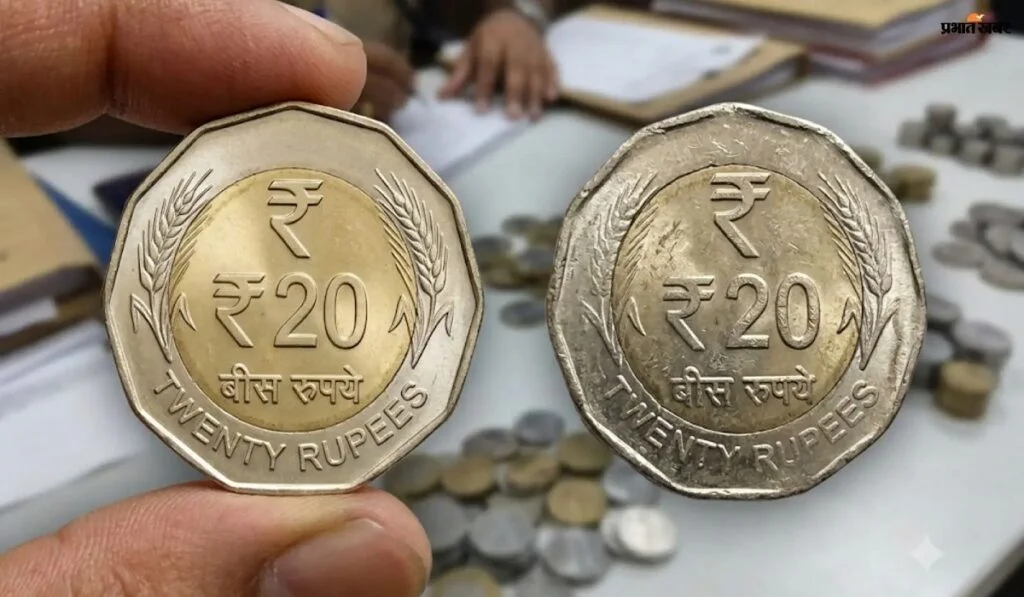
New Delhi: People are often unsure whether the new 20-rupee coins in circulation are genuine or counterfeit. At times, shopkeepers and the general public may even refuse to accept them. If you also possess a 20-rupee coin and are uncertain about its authenticity, you can verify it by checking a few specific features.
The Reserve Bank of India (RBI) has established specific design and technical standards for the 20-rupee coin. By examining characteristics such as its shape, weight, metallic composition, and the engravings on it, one can distinguish between a genuine coin and a suspicious one.
- Check the shape and edges
A genuine 20-rupee coin differs slightly from standard round coins; it features 12 edges or angles. The edges are distinct and smooth. You can assess its shape and texture by holding the coin in your hand.
- Verify by weight and diameter
A 20-rupee coin should have a weight of 8.54 grams and a diameter of 27 millimeters. If a coin’s weight or size deviates significantly from these specifications, its authenticity may be questionable.
- Composed of two different metals
A key identifying feature of the new 20-rupee coin is its bimetallic construction. The outer ring is made of nickel-silver, while the central circular portion is crafted from nickel-brass. Consequently, the coin displays a silvery-white appearance on the outside, with a golden hue in the center.
- Examine the design and engravings
On a genuine coin, the Ashoka Pillar emblem, the inscription “Satyameva Jayate,” and the numeral “20” are clearly embossed. The engravings and the lettering are sharp and well-defined. In contrast, on poor-quality counterfeit coins, the designs may appear blurred, rough, or lack clarity. 5. Color and Finishing Are Also Important
It is also essential to pay attention to a coin’s finishing. Counterfeit coins made from inferior metals are often coated with paint or a chemical polish. Such coins may appear unusual in color, or the quality of their surface may seem different.
However, a coin should not be declared counterfeit based solely on its color, smell, or the results of rubbing it. If in doubt, it is best to have it examined by a bank.

