


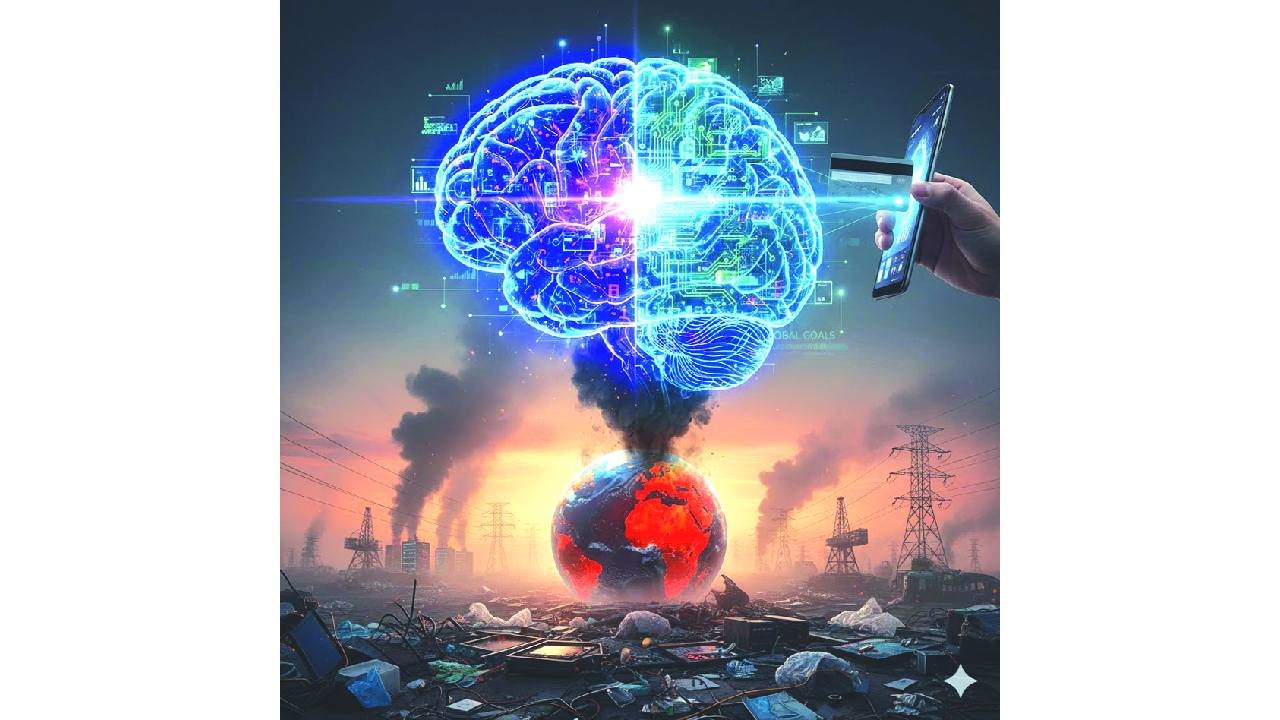
Artificial Intelligence (AI) has rapidly moved from the fringes of science fiction to the centre of modern life. It writes emails, summarises books, predicts behaviour, and solves complex problems in seconds. But as AI assumes more cognitive labour, an urgent question emerges: What is this convenience doing to the human brain; and what is it costing the planet? The power of AI is no longer in doubt. What deserves closer scrutiny is the price we are paying for ease — both biologically and environmentally.
The brain under automation
The human brain is not a static organ. Through neuroplasticity, it continually reshapes itself in response to the challenges it encounters. Learning, reasoning, and problem-solving physically strengthen neural connections, particularly in the prefrontal cortex, responsible for decision-making, and the hippocampus, essential for memory. But neuroplasticity is a double-edged sword. What strengthens with use weakens with neglect. When cognitive tasks-analysis, synthesis, recall-are consistently outsourced to AI systems, the brain is deprived of effortful engagement. Over time, this can reduce cognitive stamina, critical thinking, and independent judgment. This pattern builds on what psychologist Betsy Sparrow identified in 2011 as the “Google Effect”— the tendency to forget
information that is easily retrievable online. AI intensifies this phenomenon. Today, machines do not merely store facts; they interpret, summarise, and decide. Each time we delegate these functions, we ave time-but we also bypass the mental work required for deep understanding and long-term memory. The danger is not sudden intellectual decline. It is gradual cognitive atrophy. Like a muscle unused, the brain adapts to reduced demand.
The hidden environmental footprint
While the cognitive effects of AI unfold quietly within individuals, its environmental impact is anything but subtle. The metaphor of the “cloud” obscures a stark reality: AI is powered by vast data centres that consume enormous amounts of energy and water. Water, in particular, has become a critical and underreported cost. Large AI models rely on water-intensive cooling systems to prevent servers from overheating. In many regions, data centres already compete with agriculture and local communities for water access. Unlike energy, water has no substitute. It underpins ecosystems, food security, and human survival. This creates a troubling paradox. As AI reduces mental effort and increases convenience, it simultaneously accelerates the depletion of one of Earth’s most precious resources. We are trading cognitive engagement and environmental resilience for speed and comfort. The irony is hard to ignore: while humans risk mental passivity, machines demand ever more physical resources to stay active.
AI is not the enemy
Yet this is not a call to reject AI. Technology itself is not the problem. The danger lies in how it is used and how uncritically it is embraced. When used thoughtfully, AI can sharpen algorithmic thinking-the bility to break complex problems into structured steps, recognise patterns, and test assumptions.
In this role, AI becomes a cognitive partner rather than a substitute. It acts as a telescope for the mind, extending human vision without replacing human judgment. The difference is engagement. Passive consumption of AI-generated answers weakens thinking. Active use — questioning outputs, refining prompts, verifying conclusions-strengthens it.
Similarly, unchecked expansion of AI infrastructure worsens ecological harm, while responsible design, efficiency standards, and water-conscious policies can reduce damage. The choice is not between intelligence and technology, but between dependence and discipline.
The seduction of comfort
The most dangerous aspect of AI is not its power, but its comfort. AI does not impose itself through force. It offers ease-faster results, fewer mental demands, instant solutions. Over time, this convenience reshapes habits, encouraging intellectual surrender rather than curiosity. This transformation is subtle and continuous. It happens not in dramatic leaps, but through daily reliance.
As Netaji Subhas Chandra Bose famously warned, “Aaram haram hai”— comfort can become the enemy of progress. When effort disappears from thinking, both the human mind and the natural world bear the cost. AI does not make slaves by command. It does so by making thinking optional.
Choosing balance over dependence
AI is now embedded in everyday life, and it is here to stay. The challenge is not rejection, but restraint. Progress does not come from surrendering cognition to machines or sacrificing ecosystems for convenience. It comes from balance. If AI is treated as a crutch, human intelligence may weaken. If it is treated as a training ground — a mental gym-it can elevate human capability while respecting ecological limits.
The same principle applies environmentally: innovation without accountability accelerates depletion; innovation guided by responsibility sustains progress.Convenience should never come at the cost of cognition or sustainability. Technology should serve humanity-not quietly replace the intelligence and resources that sustain it.

