


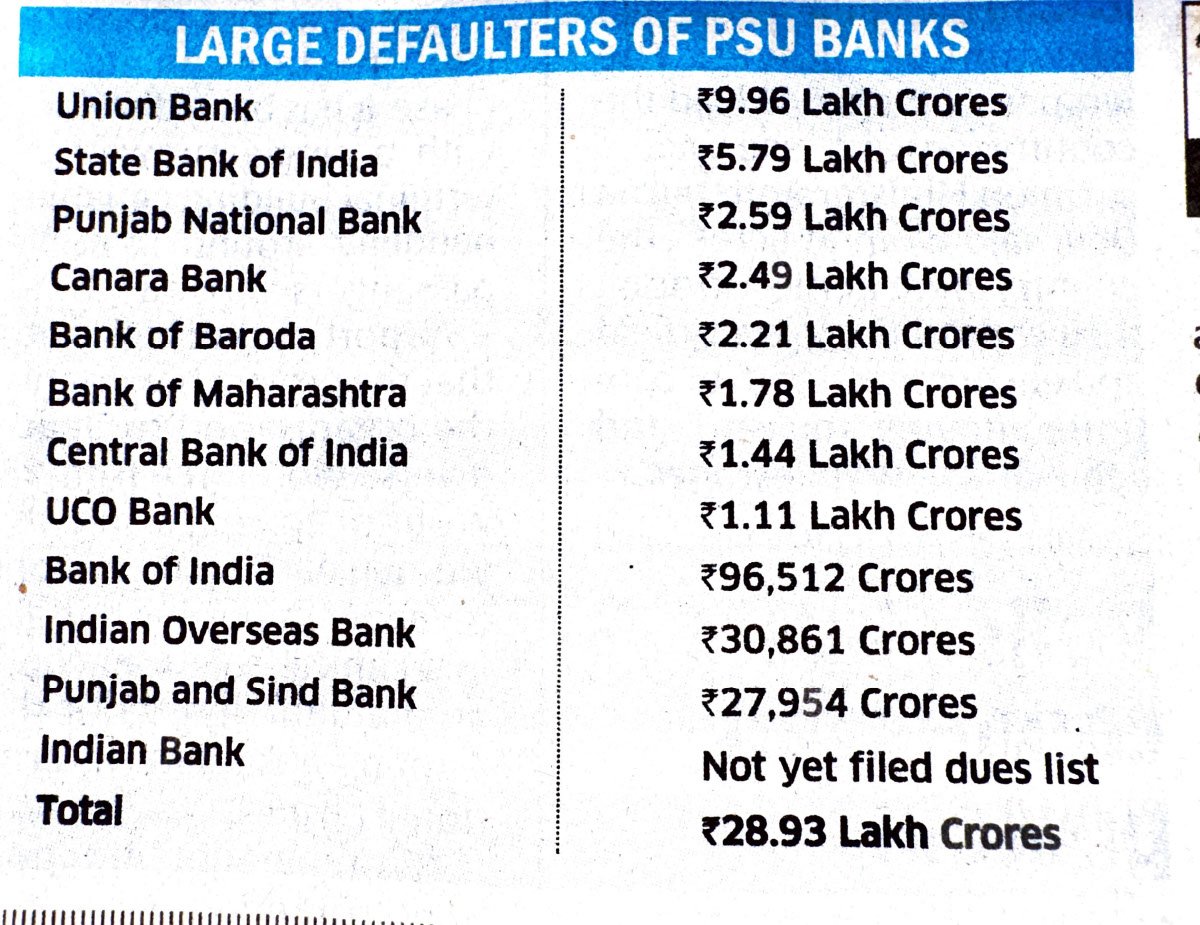
While the Union Government and the Reserve Bank (RBI) of India claim that Non-Performing Assets (NPAs) of Public Sector Undertaking (PSU) banks are at a decade’s low, the latest data on Large Defaulters of PSU banks has reached INR 29 lakh crores.
Large defaulters are borrowers with outstanding dues of INR 1 crore or more facing civil cases by banks, involving non-repayment, while NPAs are loans overdue for over 90 days, regardless of size. While NPAs may be settled by banks through a one-time settlement or settled under the Insolvency Banking Code (IBC); NPAs are defined by time-based repayment failure, whereas large defaults focus on high-value, high-risk, or wilful negligence.
Earlier in February, the Government informed the Parliament that gross NPAs as a percentage of total loans and advances of scheduled commercial banks were at a historic low of 2.15 per cent at the end of September 2025. However, there is no clarity on how these figures were arrived at.
According to publicly available data, 11 PSU banks are contesting civil cases in courts across the country to recover INR 28.93 lakh crores from corporate clients. The biggest defaulters on the list features are Anil Ambani and his companies with outstanding dues of INR 48,282 crores. Data on Large Defaulters up to January 2026 is available with rating agency TransUnion CIBIL. All PSU banks, except Indian Bank, have uploaded their lists of Large Defaulters.
This week, The Pioneer will analyse and publish records from TransUnion CIBIL detailing India’s largest defaulters.
Details of NPAs have been made available only once by the RBI. The central banker was forced to produce the data in a sealed cover to the Supreme Court (SC) in 2021 in response to a Public Interest Litigation (PIL) filed by former BJP MP Subramanian Swamy, who sought guidelines for disbursing loans to corporations. The RBI informed the court that accounts classified as NPAs belong to existing customers and banks must maintain privacy norms. The data was never made public.

