


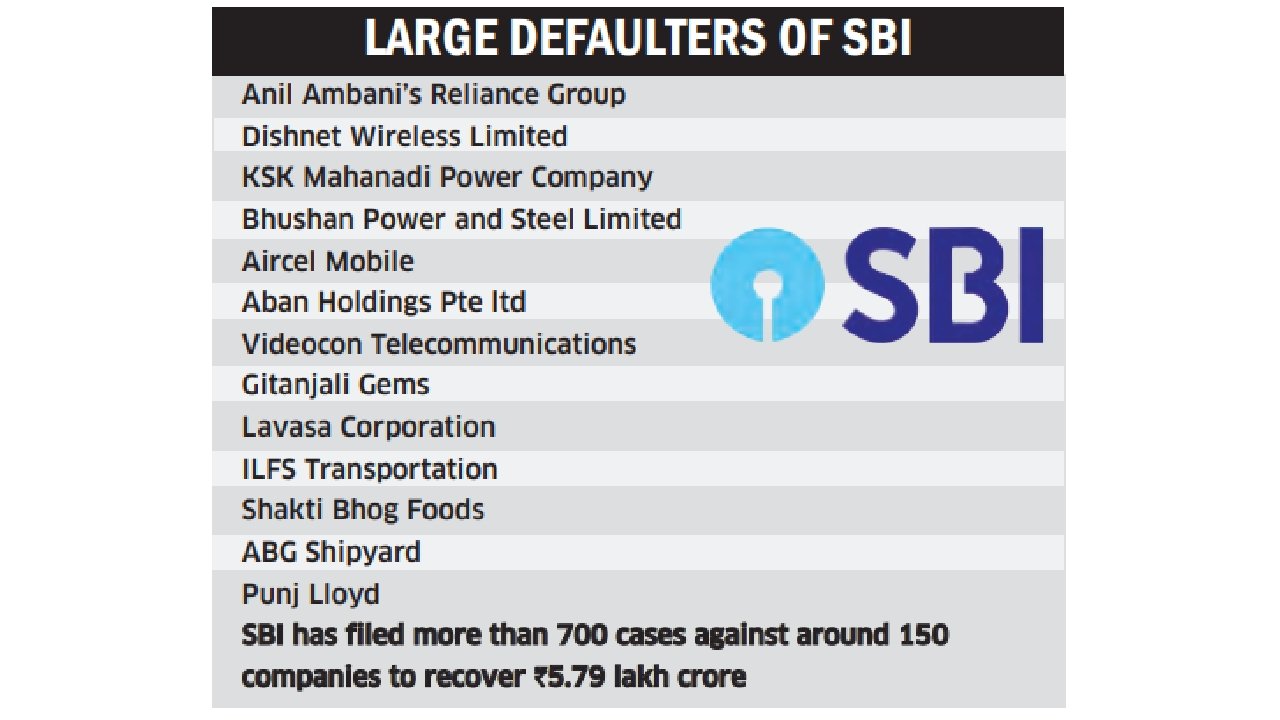
The relationship between banks and large corporate borrowers in India often raises questions, especially when it comes to granting huge loans and recovering them after default. Data about cases filed by the State Bank of India (SBI) against large defaulters shows patterns that appear complex and sometimes puzzling.
For instance, SBI has filed two civil cases against fugitive C Sivasankaran’s company Dishnet Wireless Limited. Sivasankaran gained notoriety in the Aircel-Maxis case, where P Chidambaram and his son Karti Chidambaram were involved in a quid-pro-quo in granting Foreign Investment Promotion Board clearance to Maxis Communications to acquire 74 per cent of Aircel.
According to data from TransUnion CIBIL, SBI filed two cases against Dishnet for defaulted loans of INR 4,856 crore each, totaling INR 9,712 crore. However, different guarantors are listed in the two suits. One case names Sivashakaran’s partner Suneeta Reddy, a director of Apollo Hospitals, while the other lists Anand Swarup Pathak as guarantor.
A similar pattern appears in cases involving Anil Ambani and his companies. Although SBI lists Alok Industries Limited with INR 6,299 crore dues as the biggest defaulter, a closer analysis suggests companies linked to Ambani owe about INR 13,633 crore. SBI split these loans into 16 accounts, resulting in 16 civil cases. The loans were given to several now-defunct Reliance group companies, including Reliance Communications, Reliance Naval and Engineering Limited, Reliance Telecom, and Reliance Infratel.
Another major case involves KSK Mahanadi Power Company Limited, which owes SBI INR 11,445 crore in three cases. The company was named in the 2012 Coal Allocation Scam and was later taken over by JSW Energy, headed by Sajjan Jindal, under the Insolvency and Bankruptcy Code in 2025. Similarly, SBI lists four defaults totaling INR 15,244 crore against Bhushan Power & Steel Limited, which also went through the insolvency process.
Some cases involve companies based abroad. For example, Aban Holdings Pte Limited borrowed INR 5,476 crore from SBI’s Chennai office. Although run by individuals of Indian origin and registered in Singapore, questions remain about how such loans will be recovered if they were issued without strong collateral. SBI also extended large loans to companies facing corruption or fraud allegations. For example, Videocon Telecommunications Limited, part of the Videocon Group led by Venugopal Dhoot, received INR 1,944 crore through four accounts from the same SBI branch in New Delhi. The group was later implicated in a bribery case involving former ICICI bank head Chanda Kochhar and her husband Deepak Kochhar.
Other examples include two cases against Mehul Choksi’s company Gitanjali Gems for INR 713 crore, and eight loans totaling INR 999 crore given to Lavasa Corporation Limited headed by Ajit Gulabchand. Splitting loans into multiple accounts from the same branch often leads to several separate court cases.
Similarly, SBI filed nine cases against IL&FS Transportation Networks Limited for INR 1,140 crore, two against Shakti Bhog Foods Limited for INR 3,843 crore, and four each against ABG Shipyard Limited and Punj Lloyd Limited for INR 6,927 crore and INR 6,619 crore respectively. Notably, these firms took multiple loans from the same SBI branch.
Overall, SBI has filed more than 700 recovery cases against about 150 companies with dues above INR 500 crore. In some instances, shell companies obtained large loans, sometimes sharing addresses with major firms or listing them as guarantors.
When loans become Non-Performing Assets (NPA) and cannot be resolved through settlements or insolvency proceedings, banks file civil cases and report defaulters to TransUnion CIBIL. Two lists are maintained: the “Large Defaulters” list (dues above INR 1 crore) and the “Willful Defaulters” list (dues above INR 25 lakh).
Interestingly, the latest willful defaulter list from SBI includes two small accounts of Kingfisher Airlines, each with dues of INR 28.34 lakh. The guarantors listed are fugitive businessman Vijay Mallya and his company United Breweries. Earlier, Finance Minister Nirmala Sitharaman told Parliament that banks had recovered INR 14,000 crore from Mallya. Mallya later challenged this in the Karnataka High Court, arguing that his total dues were only about INR 8,000 crore.
Overall, these cases highlight the complexity of large corporate lending in India and raise questions about how such massive loans are granted, monitored, and eventually recovered.

