


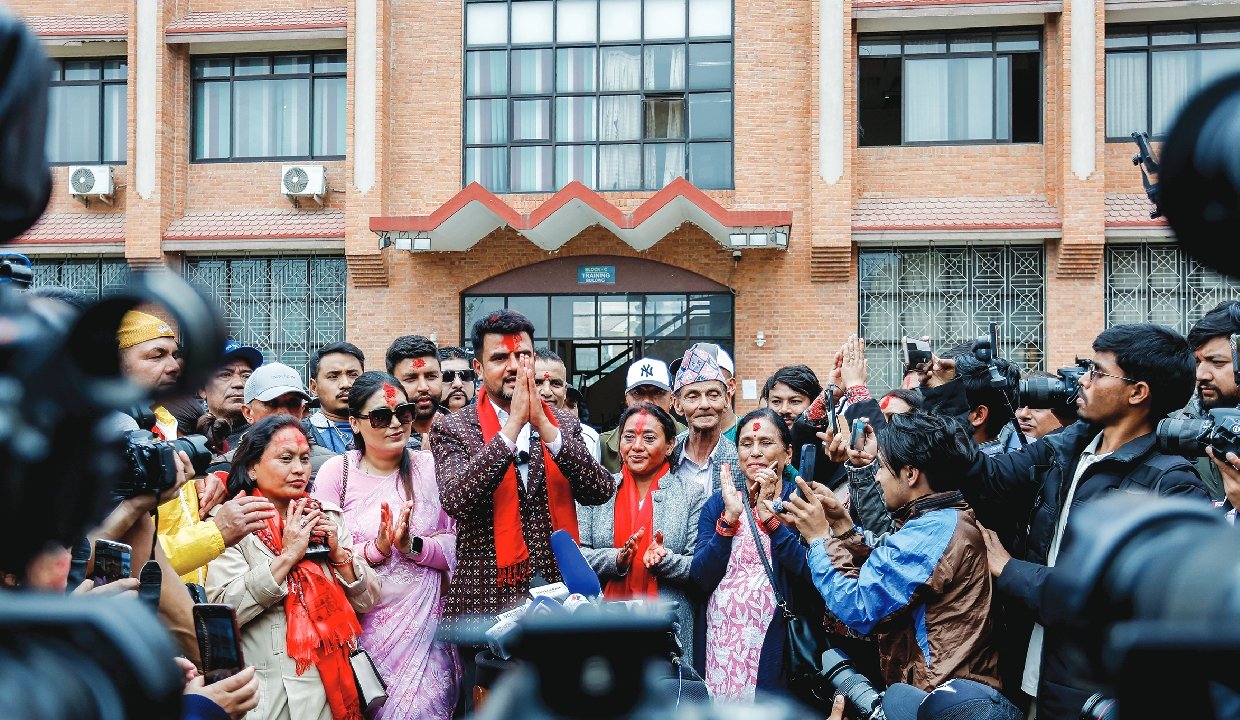
RSP’s Balendra Shah on Saturday defeated four-time PM K P Sharma Oli by a huge margin and set to form the next Government in Nepal.
Prime Minister Narendra Modi on Saturday congratulated the people and the Government of Nepal for the successful conduct of elections. Rapper-turned-politician Balendra Shah ‘Balen,’ the prime ministerial candidate of the Rastriya Swatantra Party (RSP) defeated Oli, the chair of Nepal’s legacy party, the Communist Party of Nepal (Unified Marxist–Leninist) — CPN-UML — by a huge margin of about 50,000 votes in Jhapa-5 constituency. Balen, 35, secured 68,348 votes against 74-year-old Oli’s 18,734, the Election Commission (EC) said.
The RSP, which was formed in 2022 by Ravi Lamichhane, has won 70 seats out of the 87 seats for which results have been declared by 8:30 pm, according to the Election Commission (EC).
RSP’s seats include a clean sweep in all 10 constituencies of Kathmandu district, even as it is leading in 52 seats across the country, the EC data showed.
Legacy parties were far behind in convincing voters, for whom the major issues included fighting corruption and an end to nepotism apart from a generational change in political leadership of the Himalayan nation. The Nepali Congress (NC) won ten and was leading in nine seats; the CPN-(UML) won just three seats and is leading in eight; the Nepali Communist Party (NCP) won two seats and is leading in five, the Shrama Shakti Party (SSP) was leading in three seats, and the Rastriya Prajatantra Party (RPP) won one seat, the EC data showed. Among the winners is one independent.
Nepal witnessed about 60 per cent voter turnout during the March 5 elections to the House of Representatives. The counting of votes started late Thursday night and as of 5 pm Saturday, counting was in progress in 162 constituencies, the Election Commission said. The election was being closely watched by India, which is hoping for a stable Government in the politically fragile Himalayan nation to take forward the developmental partnership between the two sides.
PM Modi said that as a close friend and neighbour, India remains steadfast in its commitment to working closely with the people of Nepal and its new Government to scale new heights of shared peace, progress and prosperity.
“Balen Babu, congratulations for the victory,” Oli wrote in his social media post. Oli, who too was projected as the PM face of the CPN-UML, wished Balen for a full five-year tenure for his Government in the Himalayan nation that has seen 14 Governments in the last 18 years.
“I wish your five-year tenure be trouble-free, successful and hearty congratulations,” Oli said as he attached a 2022 photo showing him gifting a tabla to Balen after the rapper-turned-politician won Kathmandu mayor’s election as an independent.
The RSP, which projected Balendra as its prime ministerial candidate and had organised its first election campaign in Janakpur in Madhesh, is heading towards a clean sweep of the province.
‘Balen’, as he is popularly known, projected himself as the “son of Madhesh” during the campaign, with the party launching the campaign with ‘Ab ki bar Balendra Sarkar’ (This time there will be Balendra’s Government) tagline.
Of the total 32 seats in eight districts of Madhesh province, the RSP has won eight and is leading in 22 other constituencies, the EC said.
The party is also making a clean sweep in the Kathmandu Valley, winning all 10 seats of Kathmandu district and two in Bhaktapur and one in Lalitpur district.
The party is also leading in the remaining two seats of the Kathmandu Valley with a huge margin, possibly as a result of a massive road show led by Balen in all 15 constituencies on the last day of the election campaign.
The 35-year-old engineer-turned-rapper-turned-politician is expected to be the next prime minister of Nepal, reflecting a public mood of rejection of established parties. Nepal has had 14 Governments in the last 18 years.
RSP chairman Lamichhane won with a huge margin from Chitwan-2 constituency, marking his third consecutive victory with 54,402 votes against his nearest rival, NC’s Mina Kumari Kharel, who received 14,564 votes.
According to the Election Commission, former prime minister and NCP leader Pushpa Kamal Dahal Prachanda won from Rukum Purba district by securing 10,240 votes against his rival Lilamani Gautam of CPN-(UML), who got 3,462 votes.
RPP’s Gyanendra Shahi won from the Jumla constituency of Karnali province by defeating his closest rival Naresh Bhandari of the NCP and became the only candidate of the pro-monarchist RPP to have secured a seat in the House of Representatives.
Meanwhile, the RSP is also leading in the proportional voting system, with the party bagging 474,266 votes, followed by the Nepali Congress with 160,384. The CPN (UML) has received 127,841, the Nepali Communist Party 65,363, the RPP 34,154, and the Shrama Shakti Party 17,437 votes till now.
Out of a total of 275 members of the Parliament, 165 are being elected through direct voting, while the remaining 110 through a proportionate method.
Around 3,400 candidates were vying for 165 seats under direct voting, and 3,135 candidates for 110 seats through proportionate voting.
The Gen Z youth, through their two-day intensified protests on September 8 and 9 last year, ousted Prime Minister Oli of the CPN-(UML), who was heading a coalition Government with the backing of the Nepali Congress that enjoyed nearly two-thirds majority support.
Though Balen was a popular choice to lead the interim Government after Oli’s ouster, he declined to lead the interim administration, saying he would prefer to contest the parliamentary election for a full term.
In January, he joined the RSP and was soon declared the party’s prime ministerial candidate.
The major issues raised by Gen Z before and during the election campaign were anti-corruption, good governance, an end to nepotism, generational change in political leadership, etc.

