


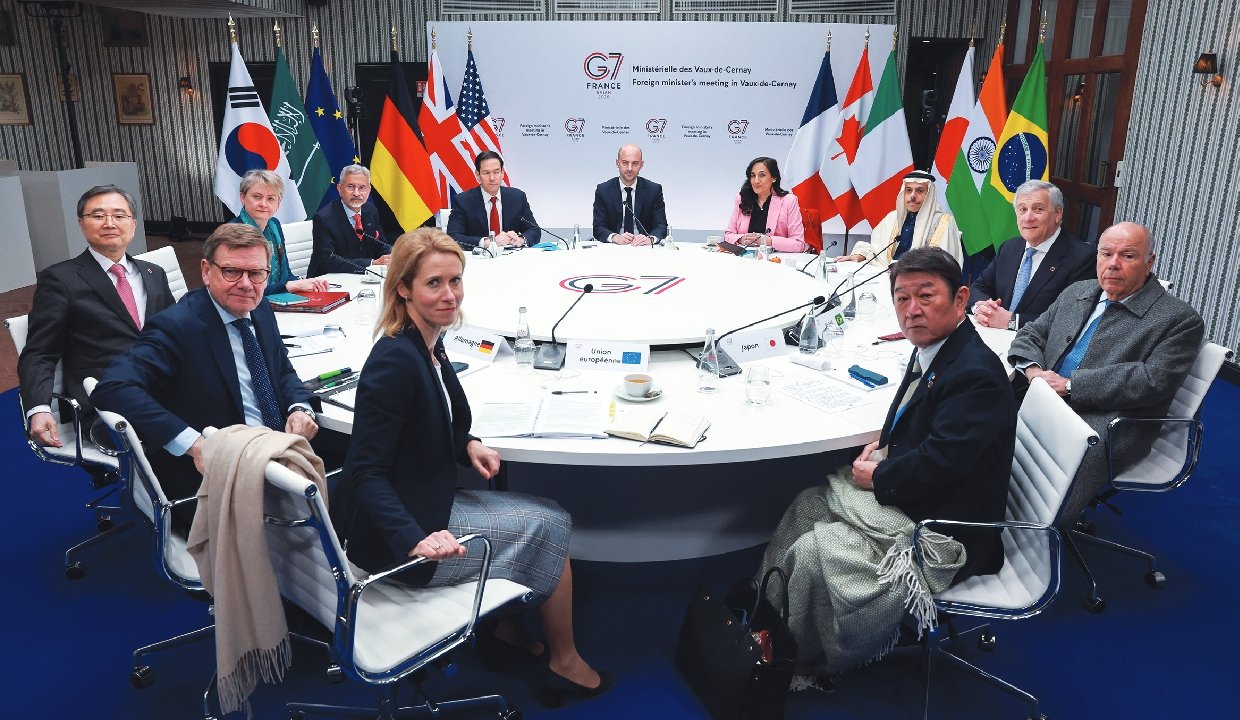
The West Asia crisis and its consequences figured prominently during a conversation between External Affairs Minister S Jaishankar and his Canadian counterpart Anita Anand on the margins of a G7 meeting in France.
Jaishankar arrived on Thursday for the G7 Foreign Ministers’ Meeting.
On its sidelines, he met Anand, and the two followed up “on the partnership our Prime Ministers advanced during our visit to India earlier this year,” the Canadian Foreign Minister said in an X post. They also discussed “Trade, the situation in the Middle East, and key areas where we can deepen cooperation, including critical minerals, agriculture, and education,” she said.
At the two-day G7 meeting, Jaishankar will discuss the West Asia crisis with a focus on coordinating efforts to ensure that the Strait of Hormuz remains open for international shipping.
External Affairs Minister S Jaishankar also highlighted the urgency of United Nations Security Council (UNSC) reforms, streamlining peacekeeping operations, and strengthening humanitarian supply chains at the G7 Foreign Ministers’ Meeting in France. “Spoke at the @G7 Foreign Ministers’ Meeting session with invited partners on reform of global governance. Highlighted the urgency of UNSC reforms, streamlining peacekeeping operations, and strengthening humanitarian supply chains,” Jaishankar posted on X.
India has been at the forefront of the years-long efforts to reform the UNSC, saying it rightly deserved a place as a permanent member in the United Nations.
The narrow shipping lane between the Persian Gulf and the Gulf of Oman handles roughly 20 per cent of global oil and LNG (Liquefied Natural Gas), and global oil and gas prices have surged after Iran virtually blocked it.
The G7 meeting, being held at Abbaye des Vaux-de-Cernay on March 26–27, came at the invitation of Minister for Europe and Foreign Affairs of France Jean-Noel Barrot.
The Group of 7 (G7) brings together seven of the world’s most advanced economies: Canada, France, Germany, Italy, Japan, the UK and the US. The European Union is also a member of the bloc.
The G7 serves as the forum of choice for its members to discuss and coordinate action in response to major economic, financial and geopolitical challenges on the global stage.
Jaishankar greets his Nepal counterpart
External Affairs Minister S Jaishankar on Friday extended his greetings to his Nepali counterpart, Shisir Khanal, and looks forward to working closely to further strengthen the traditional partnership.
“Warm wishes to Shisir Khanal on taking over as the Minister for Foreign Affairs of Nepal. @shisir,” Jaishankar said in a post on X. Nepal’s new Prime Minister, Balendra Shah, on Friday, along with his ministers, took oath at the special ceremony held at the official residence of the President, Shital Niwas, in Kathmandu.
“Look forward to working closely with him to further strengthen our traditional partnership. @MofaNepal,” he added.
Nepal is important for India in the context of its overall strategic interests in the region, and leaders of the two countries have often noted the age-old “Roti Beti” relationship.
Landlocked Nepal relies heavily on India for the transportation of goods and services. Nepal’s access to the sea is through India, and it imports a predominant proportion of its requirements from and through India.

