


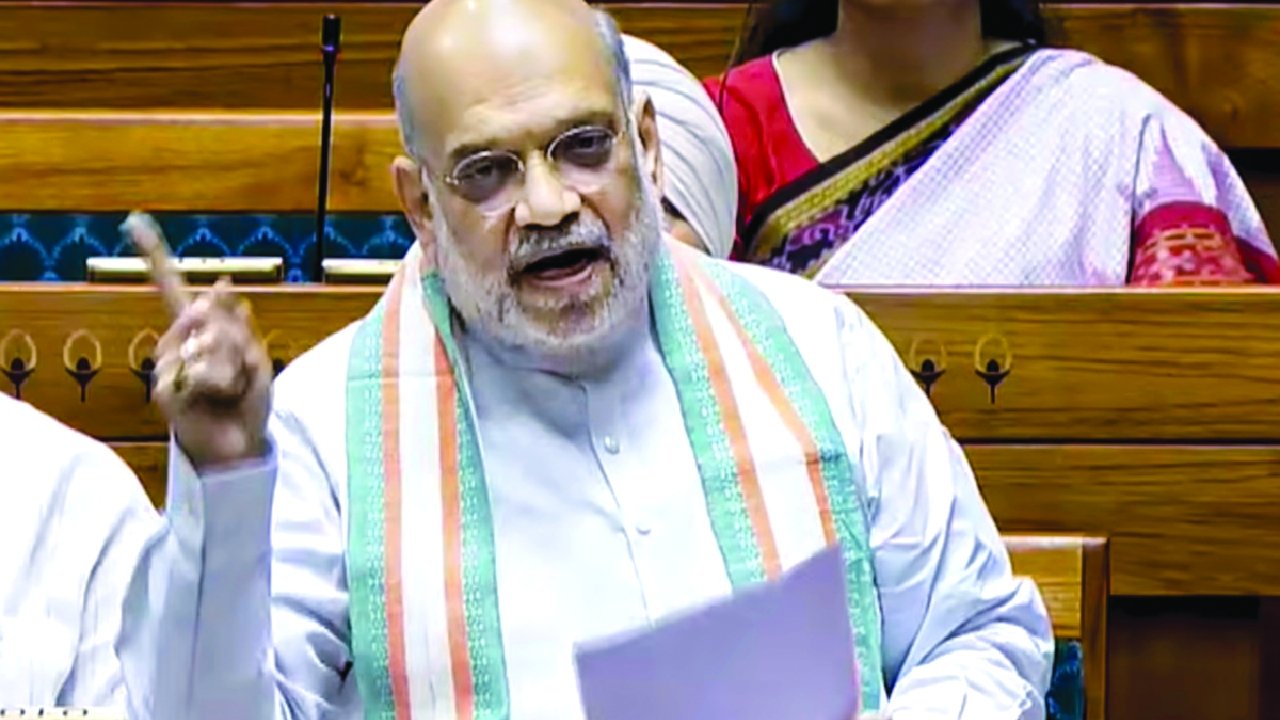
In a significant address in the Lok Sabha on Monday, Union Home Minister Amit Shah proclaimed that the decades-long spectre of Maoist insurgency, often referred to as Naxalism, is nearing complete eradication across India. With the Union Government’s self-imposed deadline of March 31, 2026, just one day away, Shah described Chhattisgarh’s Bastar region, long considered the final stronghold of Left-Wing Extremism (LWE), as now firmly “on the path of development” following the lifting of the “shadow of Red Terror.”
The Lok Sabha debate on Prime Minister Narendra Modi Government’s efforts to end Maoist violence came as Parliament discussed the progress toward a “Naxal-Mukt Bharat.” Shah, responding to the discussion, asserted that sustained security operations, development initiatives, and rehabilitation policies have brought the country to the brink of victory over what was once one of India’s most intractable internal security challenges.
Shah painted a picture of transformation in Bastar, the epicentre of Maoist activity in Chhattisgarh. “Today, Naxalism has been almost eradicated from Bastar,” he declared.
The Home Minister outlined a series of targeted development drives launched by the Union and the State Governments to speed up developmental work in the Naxal free areas. A campaign to establish a school in every single village, establishment of Primary Health Centres (PHCs) and Community Health Centres (CHCs) in every Tehsil and Panchayat and issuance of Aadhaar cards and ration cards to residents, enabling the distribution of five kilograms of food grains per person, has been taken up on a war footing.
These measures, Shah emphasised, were previously impossible due to the pervasive Red Terror that had isolated tribal communities and blocked basic governance. “The people of Bastar were left behind precisely because the shadow of ‘Red Terror’ loomed over the region; that is why development failed to reach them,” he said
Addressing voices calling for dialogue with remaining Maoist groups, Shah reiterated the Government’s clear stance, which he has voiced multiple times during public events in Bastar.
“Lay down your arms, and the Government will ensure your rehabilitation,” he said. However, he drew a sharp line, “Our Government’s policy is clear, we are open to dialogue with those who surrender their weapons. Those who choose violence will be met with a firm response.”
The discussion quickly turned political, with BJP members accusing the Congress of allowing Maoism to proliferate during its nearly 60 years in power out of India’s 75 years of independence. Shah escalated the critique, linking the human cost of the insurgency directly to past Governmental failure. Maoist violence has claimed the lives of approximately 20,000 young people and affected over 120 million citizens, he noted.
“It was a failure of the Congress Government that tribal and several other communities were deprived of development,” Shah said. “Over the last 75 years, the Congress party governed for 60 years. Why, then,did the tribal communities remain deprived of development?, Shah thundered.
“He invoked a statement by former Prime Minister Dr. Manmohan Singh, who had described Naxalism as a greater internal threat than militancy in Kashmir or the North-East. “Despite this, nothing was done,” Shah remarked, underscoring what the BJP portrays as historic inaction by the previous regime.
The March 31, 2026 deadline was first prominently set by Shah in late 2025 and repeatedly reaffirmed in 2026 during visits to Bastar and other affected regions. Earlier this year, he had highlighted an 85 per cent drop in civilian killings by Naxalites and the liberation of 9 per cent of previously Maoist-dominated areas. Development indicators in Bastar, including reopened schools, new roads, mobile towers, electricity, and drinking water have been cited as proof that security gains are being converted into tangible progress for tribal populations.
While the Government expresses confidence that the March 31 target will be met, officials have indicated that residual pockets, if any, will be addressed through continued operations and development in the months ahead, with a longer-term vision to make Bastar one of India’s most developed tribal regions within five years.
Shah’s speech marks a confident assertion that India is on the cusp of fulfilling a long-standing national security goal. For years, Maoist groups controlled large swathes of the “Red Corridor” across several states, running parallel administrations and exploiting tribal grievances. The Modi Government’s multi-pronged approach and intelligence-led operations, infrastructure development under schemes like the Aspirational Districts Programme, and surrender-and-rehabilitation policies, has been credited with steadily shrinking the insurgency’s footprint.
As the clock ticks down to March 31, 2026’s deadline, Shah’s message from the floor of the Lok Sabha was unequivocal; The era of Maoist dominance is ending, Bastar is rising, and the Government remains committed to both development and decisive action against those who refuse to join the mainstream”. The debate, however, also underscored that the fight against Naxalism remains politically charged, with the ruling dispensation using the occasion to contrast its record against the Congress’s long years in office.
Whether the March 31 milestone is fully achieved or requires a final push, Amit Shah’s address signals that the “Red Terror” era is, by the Government’s reckoning. drawing to a decisive close.

