


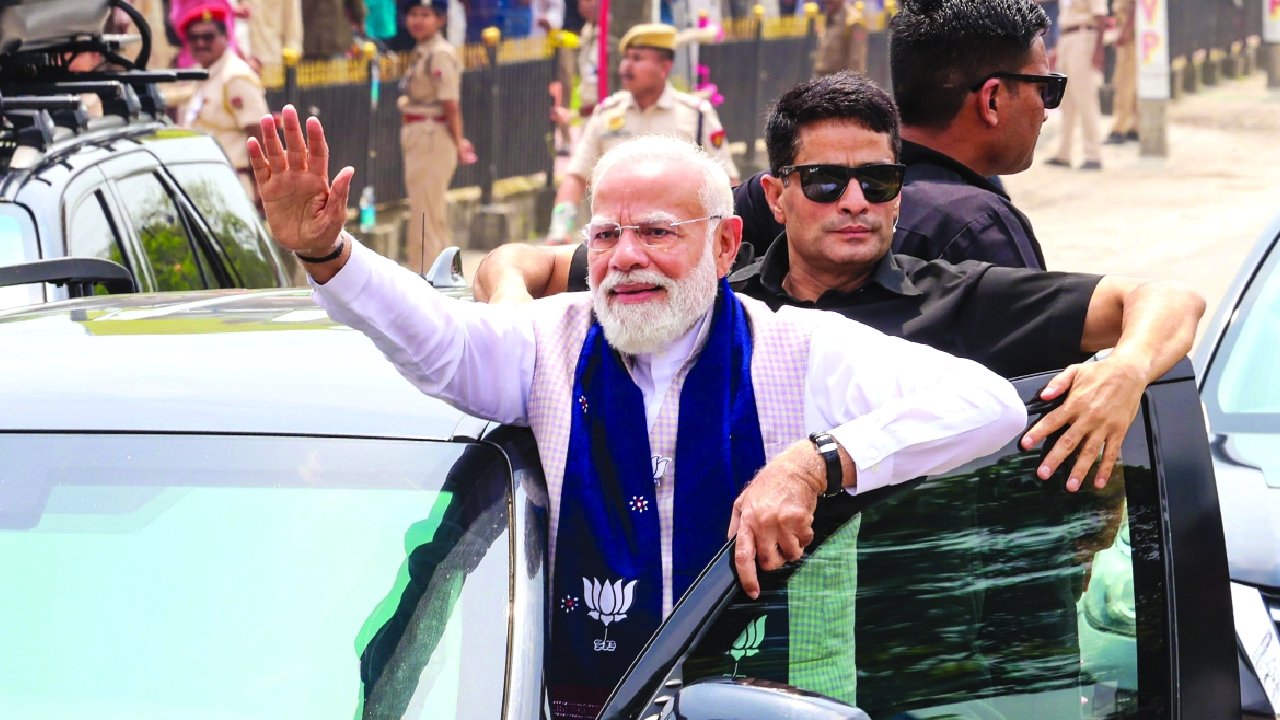
Prime Minister Narendra Modi on Monday underlined that the Uniform Civil Code (UCC) and One Nation, One Election (ONOE) are two of the unfinished agendas of the BJP on the occasion of the party’s 47th Foundation Day.
“Our mission is still ongoing. On Uniform Civil Code, ‘One Nation, One Election’ and other issues, serious discussions are taking place in the country, and we have achieved tremendous progress on those fronts,” he said.
Under the ONOE system, the Modi Government proposes to conduct simultaneous elections to the Lok Sabha and State Assemblies. The UCC seeks to create same set of laws for everyone across the country irrespective of religion, especially with regard to marriage, adoption, et cetera.
Reiterating that the BJP-led Government is committed to implementing the Women’s Reservation Bill, the PM said it was the BJP that first raised the issue of their reservation in 1994.
“We had also decided that we would encourage women in our party organisation as far as possible. When we came to power, we fulfilled that promise. Now we are fully dedicated to ensuring that the Nari Vandan Adhiniyam (Women’s Reservation Act) is implemented in the 2029 General Elections,” he said.
The women’s quota Bill aims to provide 33 per cent reservation for women in the Lok Sabha and State Assemblies. The Prime Minister’s statement came days before Parliament is scheduled to discuss the Bill for three days starting April 16.
“There are countless works that were the result of BJP’s honest efforts, such as ending hundreds of black laws from the British era, the construction of a new Parliament building, 10 per cent reservation for the poor in the general category, triple talaq ban, the Citizenship Amendment Act, the construction of Ayodhya Ram temple,” he said.
Highlighting that the BJP-led NDA has completed 25 years of existence, the PM said it is the only coalition that has been working for the interests of the country and the welfare of its people.
“Works are ongoing on issues such as the demographic change, infiltration, corruption, dynastic politics, and freeing people from the slave mentality. The BJP has to make the country free from all these challenges. This responsibility can be fulfilled only by the BJP,” he said.
Referring to the abrogation of Article 370 (which gave special status to Jammu and Kashmir) in 2019, Modi said that for decades, the law was a hurdle in fully integrating Jammu and Kashmir with the rest of the country. “People thought it was impossible to scrap Article 370, but we had promised to abrogate it. We have completed the task,” he said.
Modi said the BJP has been maintaining a consistent stand on issues like national security and terrorism, and now new technologies are being installed for border security, the border villages are being developed, and the backbone of Naxals has been crushed.
He said that under the “vast and sacred banyan tree” of the Rashtriya Swayamsevak Sangh, the BJP was inspired to step into politics with good intentions and integrity. “In the initial few decades, we devoted our energy to setting policies for the organisation,” he said.
PM Modi said people have seen dynastic politics, which is still prevalent in some parts of the country, and the Left governance model, but the BJP’s governance model is unique. “Under our governance model, policies and Governments are stable,” he said. He added that the party cannot forget that in 1984, the Congress won a record number of seats, but the country also witnessed how they betrayed the people.
“This increased people’s trust in the BJP, and slowly we began to win seats. At that time, two types of political ideologies existed: one was power-driven, and the other was service-oriented,” he said. The politics that prioritised power gradually declined, and service-oriented politics gained massive public support. Today, we are proud that through our conduct, we have established a new principle in Indian politics: the principle of nation first,” he said.

