


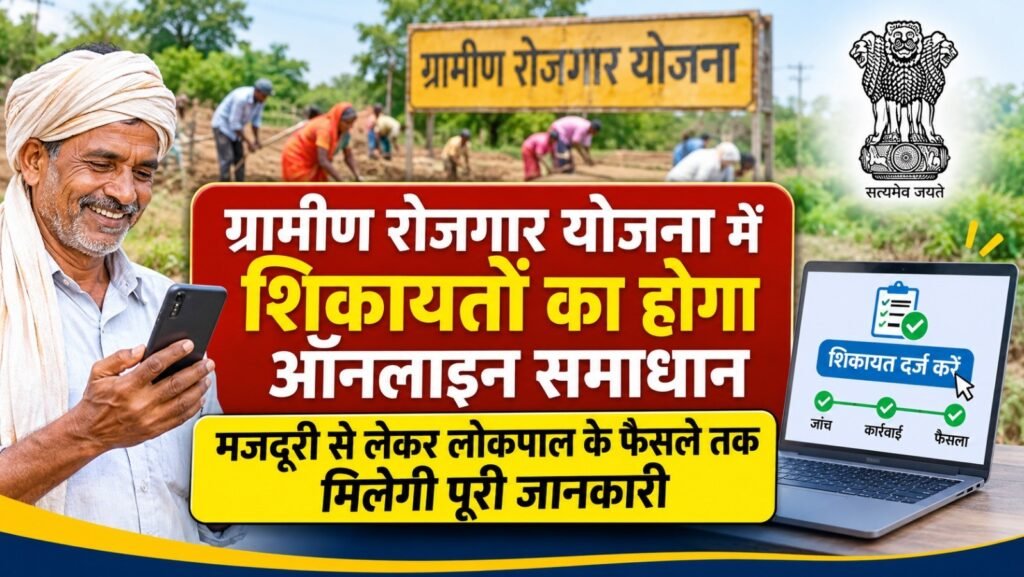
There is welcome news for rural workers across the country, including those in Chhattisgarh. They will no longer need to make repeated visits to government offices to resolve issues such as delayed wage payments under rural employment schemes, errors in job cards, or non-payment for work already performed. Under the ‘VB-G Ram Ji Act, 2025’, the Ministry of Rural Development is developing a dedicated digital platform. Once this system is implemented, rural workers will be able to file grievances online and track the subsequent action taken—all from the comfort of their own homes.
The digital platform will maintain a comprehensive record—from the initial filing of a grievance and its investigation to the actions taken by relevant officials and the final decision rendered by the Ombudsman. This will ensure transparency in the grievance redressal process and make it easier for rural workers to stay informed about the status of their cases.
End-to-end online monitoring: From grievance filing to final decision
The Ministry of Rural Development has issued new guidelines for the Ombudsman and the Appellate Authority, emphasizing that the entire grievance redressal process should be managed digitally.
Under this new system, rural workers can file complaints online. They will be able to track the progress of their grievances—including the actions taken, the stage of the investigation, and the final decisions reached—directly on the digital platform. Furthermore, the proceedings of the Ombudsman and their final orders will also be uploaded online.
This will spare complainants the trouble of repeatedly visiting government offices to seek updates. Additionally, it will make the grievance redressal process more transparent and accountable.
Grievances can be filed regarding wage payments, job cards, and employment-related issues
Through this new system, rural workers can lodge various types of complaints related to employment schemes, specifically concerning the following issues:
Incorrect information or other discrepancies in job cards.
Failure to provide employment despite a formal request.
Non-payment of wages for work performed.
Delays in wage payments and the failure to receive compensation for such delays. Complaints regarding irregularities and fraud in muster rolls.
Failure to provide essential facilities at the workplace.
Discrimination against or harassment of women and vulnerable sections of society.
Through these complaints, rural workers will be able to bring issues concerning their rights to the attention of the relevant authority.
Geo-tagged photographs to facilitate monitoring of the Ombudsman’s inspections.
The digital system will not only facilitate the filing of complaints but will also maintain an online record of all activities related to investigations and inspections.
When the Ombudsman visits an area to investigate a complaint, they will be required to upload geo-tagged and time-stamped photographs during the inspection. This will clearly establish the location and time at which the inspection took place.
Furthermore, details regarding the actions taken during an investigation and the final decision on a complaint will be available on the digital platform. This will enhance transparency throughout the process and help the complainant stay informed about the current status of their case.
The Ombudsman will participate in at least three social audit public hearings every month.
The new system includes specific provisions to strengthen monitoring and accountability at the rural level. According to the new guidelines, the Ombudsman is required to attend at least three social audit public hearings or Gram Sabha meetings each month.
This will provide villagers with an opportunity to present their concerns directly to the Ombudsman. Additionally, it will enable necessary corrective actions to be taken based on any irregularities or individual grievances identified during these social audits.
Expanded eligibility criteria for the appointment of the Ombudsman.
To improve the grievance redressal mechanism, the eligibility criteria for the appointment of the Ombudsman have been revised. Under the new guidelines, individuals with experience in fields such as rural development, law, public administration, education, social work, or management are now eligible for appointment as an Ombudsman.
The objective is to entrust this responsibility to experienced individuals who can understand the challenges faced by rural workers and address them through impartial investigation and resolution. Overall, this digital system—being developed under the VB-G Ram Ji Act, 2025—represents a significant step toward simplifying the process for rural workers to file grievances and receive updates on the actions taken. It is expected to enhance transparency and accountability in resolving issues related to wages, employment, and job cards.

