


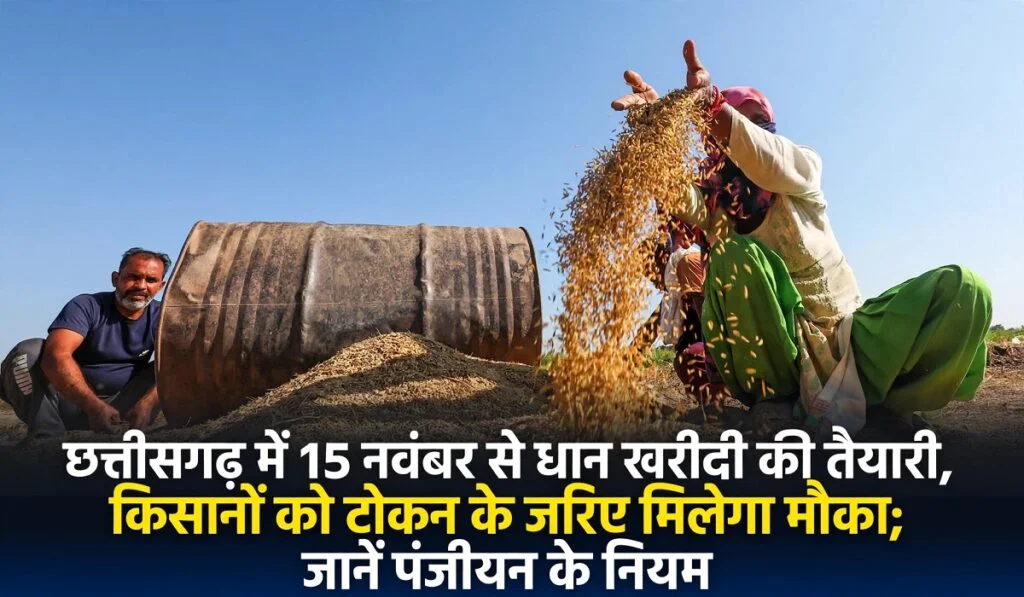
Raipur: Preparations for paddy procurement in Chhattisgarh for the Kharif marketing year 2026-27 have gained momentum. It is expected that paddy procurement in the state will commence on November 15, as it has in previous years. A decision regarding the paddy procurement policy is likely to be taken during the state cabinet meeting scheduled for October 27. However, the final confirmation of the procurement dates, targets, and regulations will only be made following an official announcement by the government.
The proposed framework places special emphasis on farmer registration, a token system, biometric verification, the quality of the paddy, and the monitoring of procurement centers. Farmers are advised to ensure that their land records, registration details, and bank account information are accurate and up-to-date before the procurement process begins.
Proposal for Paddy Procurement from November 15 to January 31
According to available details, paddy procurement for the Kharif marketing year 2026-27 is proposed to take place from November 15, 2026, to January 31, 2027. Reports indicate that a procurement target of 16 million metric tonnes (160 lakh metric tonnes) is being considered, though this will only be officially confirmed once the final policy is released.
In the previous Kharif marketing year (2025-26), paddy procurement in the state was also conducted from November 15 to January 31, with a target of 16 million metric tonnes.
Proposal for Procurement of up to 21 Quintals of Paddy per Acre
The proposed policy includes a provision to continue the procurement of up to 21 quintals of paddy per acre from farmers. However, the actual quantity procured may be determined based on the average yield as established by the Revenue Department. If the determined average yield is less than 21 quintals per acre, the procurement limit will be adjusted accordingly.
The objective of this system is to ensure that paddy procurement aligns with actual production and to prevent any irregularities. The final rules for the 2026-27 season will be confirmed through a notification issued by the state government.
What will be the MSP for paddy?
The central government has announced the Minimum Support Price (MSP) for paddy for the Kharif marketing season 2026-27:
Common paddy: ₹2,441 per quintal
Grade-A paddy: ₹2,461 per quintal
These are the Minimum Support Prices set by the central government. In Chhattisgarh, the additional amount provided under the ‘Krishak Unnati Yojana’ (Farmers’ Prosperity Scheme) and the specific payment terms are different. The total payment that farmers in the state will receive will be confirmed by the new paddy procurement policy and the relevant government orders.
Selling paddy without a token may cause difficulties
A token system will be essential for selling produce at paddy procurement centers. This system allows farmers to visit the center on a designated date to sell their paddy.
According to the proposed details, farmers may be required to apply for a token at least seven days before the date on which they intend to sell their paddy. It is suggested that small and marginal farmers may be issued a maximum of two tokens, while large farmers may be issued up to three.
However, the token limits and the process for issuing tokens via a mobile app were governed by different provisions last year. Therefore, farmers should verify the number of tokens allowed, the application timeline, and the booking procedure once the new policy is released.
AgriStack registration and land records are mandatory
Registration on the ‘AgriStack’ portal is essential for farmers looking to sell their paddy. This digital system focuses on linking a farmer’s identity, land records, and procurement-related information.
Farmers should verify their registration details, land-related documents, and bank account information. Those farming on leased land (under Adhiya or Regha arrangements—sharecropping or fixed-rent lease agreements) may be required to submit the landowner’s consent along with other necessary documentation. The final terms applicable to such cases will be clarified in the official policy. Procurement to be Subject to Biometric Verification
The proposed system mandates the continuation of biometric authentication during paddy procurement. Under this process, the farmer’s identity will be verified before the procurement is finalized.
According to the rules, farmers may sell their paddy either in person or through an authorized representative. Once the procurement is complete, payment will be credited to the farmer’s bank account in accordance with the established procedure. Farmers will also receive a computer-generated receipt upon the sale of their produce.
Paddy with Moisture Content Exceeding 17% Will Not Be Accepted
To ensure the quality of the paddy, moisture levels will be checked at the procurement centers. As per the proposed guidelines, paddy containing more than 17% moisture will not be accepted.
Consequently, farmers are advised to thoroughly dry their paddy and ensure it meets the prescribed quality standards before bringing it to a procurement center. This rule will be formally confirmed upon the release of the new procurement policy.
Enhanced Surveillance Planned for 76 Centers in Border Districts
To prevent potential irregularities—such as bringing in paddy from other states to sell at the Minimum Support Price (MSP)—there is a proposal to increase surveillance in border areas. According to available information, special monitoring may be implemented at 76 procurement centers located in border districts.
Plans are underway to form inspection teams comprising officials from the Revenue, Food, Agricultural Produce Market (Mandi), Cooperative, Forest, and Transport departments. These teams will be tasked with monitoring for suspicious transportation, illegal storage, and any potential malpractices within the procurement process.
Provisions for the Use of Used Jute Sacks
Preparations are also being made to ensure an adequate supply of sacks (gunny bags) for paddy procurement. The current proposal suggests a rate of ₹25 per unit for used jute sacks, with an additional utility charge of ₹10.22 per unit. Both new and used sacks will be arranged through MARKFED.

