


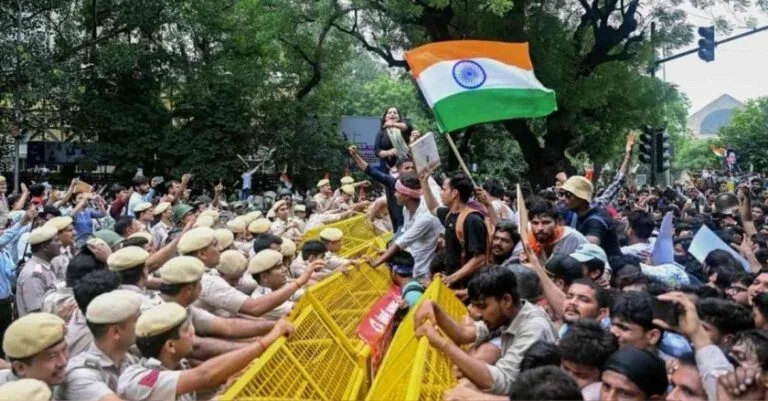
News Ghanti, New Delhi. The student protest underway at Jantar Mantar is evolving from a mere sit-in into a powerful symbol of the discontent felt by the nation’s youth. What began as a movement demanding accountability and protesting alleged irregularities in competitive examinations has now become the focal point of a national debate.
The protesters remain adamant in their demand for the resignation of Union Education Minister Dharmendra Pradhan, while the government has shown no indication of acceding to this demand so far.
A defining feature of this movement is its distinct ‘Gen Z’ style. Through social media, satire, memes, creative posters, cultural performances, and digital campaigns, the youth have given the movement an identity that has captured the attention of not only the entire nation but also the international media. Several foreign media outlets have described it as a new form of political expression among India’s youth and one of the most unique movements of the digital age.
Recent incidents—including a police lathi-charge and the harsh conduct of certain officials, as alleged by the protesters—have further intensified the controversy. Subsequently, the government initiated a dialogue, deputing Union Ministers JP Nadda and Jitendra Singh to hold talks with the protesters. However, despite two rounds of discussions, no consensus was reached on the primary demand—Dharmendra Pradhan’s resignation—and the protest continues.
Security measures at and around Jantar Mantar have been ramped up to unprecedented levels. Extensive barricading, the deployment of additional central forces, and comprehensive security arrangements have been implemented on the routes leading to Sansad Marg.
Protesters claim that obstacles were created to prevent essential supplies from reaching the protest site, though supporters have persisted in their efforts to provide food, water, and other necessities through alternative arrangements.
The movement is reportedly garnering support from across the country, with students and social organizations staging solidarity protests in various states. Opposition parties have also raised the issue both in Parliament and on the streets. Meanwhile, some BJP supporters arrived at Jantar Mantar but faced opposition from the protesters, who asked them to stay away from the stage. Many social activists, academicians, lawyers, medical professionals, and public figures have emphasized the need for reforms in the examination system and a serious dialogue regarding the concerns of the youth. Prominent figures, including Senior Advocate Vikas Singh and social activist Sonam Wangchuk, have also expressed their views on the students’ demands and the importance of peaceful dialogue.
International media has also given significant coverage to this movement. Prestigious media organizations such as the Associated Press, Reuters, The Wall Street Journal, The Guardian, and The Times have portrayed it as a reflection of growing youth discontent in India, a new form of protest driven by digital platforms, and a major emerging political challenge for the government.
Political analysts believe that the movement has moved beyond the demand for a single minister’s resignation. It is bringing broader issues—such as the education system, employment, the credibility of the examination process, and governmental accountability—to the forefront of the youth’s agenda. The challenge for the government lies not merely in maintaining law and order, but also in regaining the trust of the youth.
While dialogue between the government and the protesters is currently underway, the movement at Jantar Mantar shows signs of remaining a focal point of national politics until concrete decisions are reached regarding the key demands. Upcoming talks between the government and student organizations could determine the trajectory of this movement and its impact on the country’s political landscape.

