


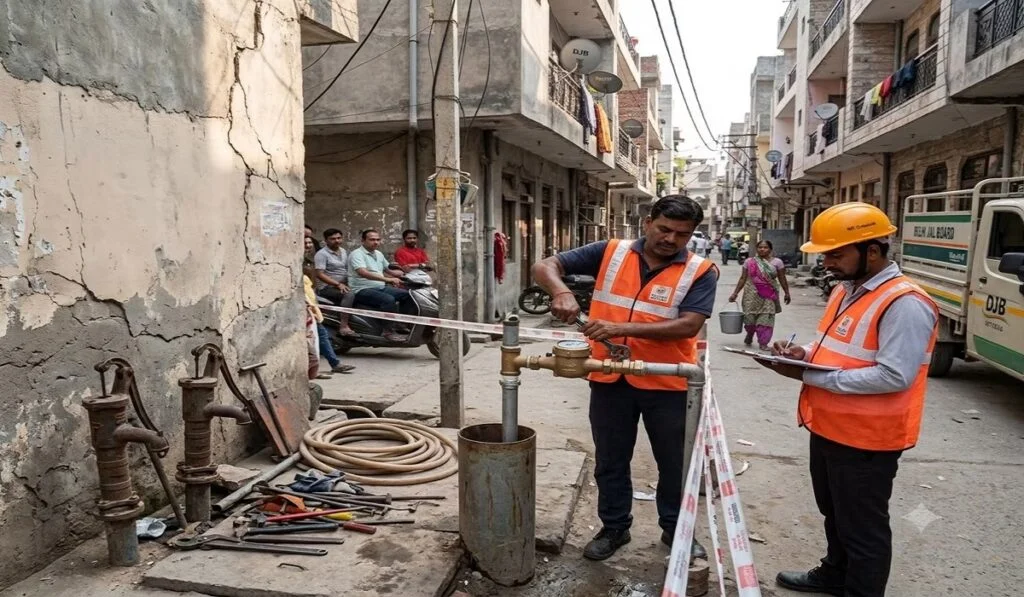
The Delhi government is preparing to introduce a new borewell policy to curb the illegal extraction of groundwater in the capital. Officials stated that the draft of this policy has already been prepared. Under the new system, the installation of water meters on all existing domestic and commercial borewells in the capital will be made mandatory to ensure accurate monitoring of groundwater usage. According to officials, the policy aims to prevent the unregulated and illegal extraction of groundwater, conserve water resources, and make groundwater management in the capital more transparent and effective. Installing water meters will help determine the volume of groundwater being extracted in different areas, enabling the implementation of necessary regulatory measures.
Officials confirmed that the policy draft is ready. The proposed policy mandates the installation of water meters on all domestic and commercial borewells to facilitate precise monitoring of groundwater consumption. They also mentioned that the new policy would include provisions to regularize the thousands of illegal borewells currently in operation. The government’s objective is to bring illegal borewells within the legal framework, thereby establishing effective monitoring and control over groundwater extraction.
Under the proposed system, water meters will be installed on all domestic and commercial borewells, and consumers will be charged based on the actual volume of groundwater extracted. A senior government official, speaking on condition of anonymity, stated that the policy aims not merely to grant one-time approval but to ensure continuous monitoring of borewells and levy user charges based on actual groundwater consumption. The new system entails installing a water meter on every borewell connection to record the amount of groundwater extracted by the consumer, with bills issued accordingly.
The official noted that while the Central Ground Water Board (CGWB) currently has the authority to impose environmental compensation for illegal borewells, there is no fixed tariff for legally extracted groundwater. For this reason, the Delhi government has sought suggestions from the CGWB and the Environment Department regarding the methodology for determining groundwater usage charges. The proposed policy will also include a process to regularize the thousands of illegal borewells operating in the capital, bringing them within the legal framework so their usage can be monitored. The government believes this will help control groundwater extraction and improve the management of water resources.
Door-to-door survey to check water connections
To curb illegal borewells in Delhi, the government is preparing to launch a door-to-door survey soon. A senior official stated that identifying illegal borewells is extremely difficult because most are located inside homes, and their numbers could run into the hundreds of thousands. The government will conduct a door-to-door survey to inspect water connections. Additionally, consideration is being given to collecting information regarding borewells from every household during the survey, enabling the accurate identification of illegal borewells and facilitating necessary action.
Under current regulations, installing a borewell in the capital without prior permission is prohibited. Applications for borewell installation are reviewed by district-level advisory committees comprising officials from the Delhi Jal Board (DJB), the district administration, the Central Ground Water Board (CGWB), and other relevant agencies. These committees generally grant permission only in areas where the groundwater level does not fall into the ‘critical’ category, thereby helping to conserve groundwater resources and prevent the water crisis from worsening.
New system to be established for monitoring groundwater extraction
A senior Delhi Jal Board official noted that the existing borewell permission system has been in place since 2010. Under this system, applicants obtain permission by paying a one-time processing fee of ₹500. However, once permission is granted, there is no effective mechanism to monitor the volume of groundwater being extracted from the borewell. According to the official, the proposed new policy aims to address this gap by mandating the installation of water meters—similar to those used for water bills—and implementing regular usage charges. This will enable monitoring of groundwater usage and help curb over-exploitation. Officials stated that the draft policy has been sent to the Central Ground Water Board (CGWB)—under the Union Ministry of Jal Shakti—to seek suggestions and determine charges for groundwater extraction. At the time of writing, no official response regarding this matter had been received from the Delhi Jal Board (DJB) spokesperson.

