


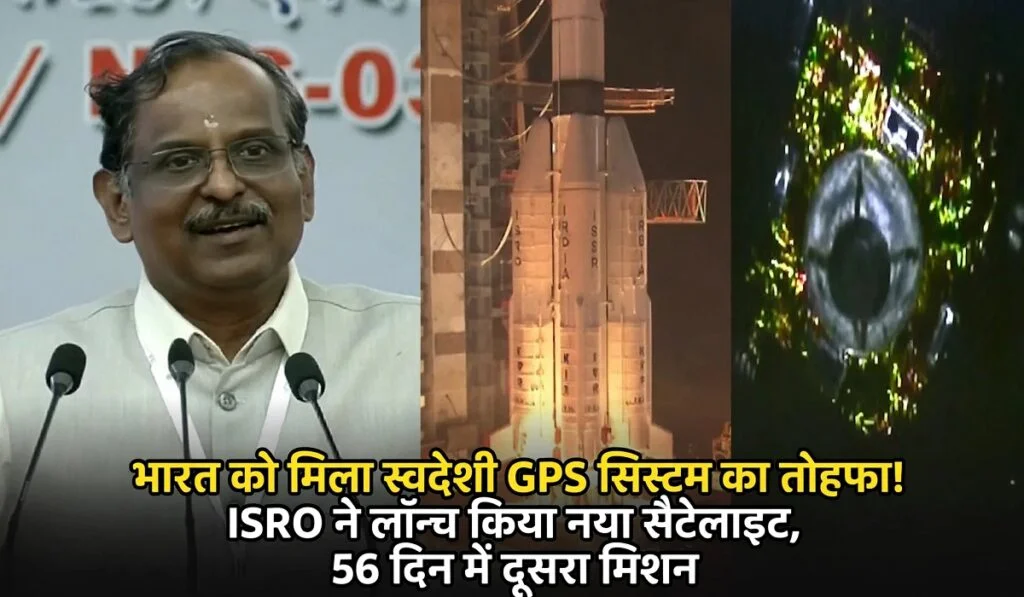
New Delhi: India has achieved another major milestone in the fields of space and navigation. On Friday night, the Indian Space Research Organisation (ISRO) successfully launched the NVS-03 navigation satellite from Sriharikota using a GSLV-F18 rocket. This launch, which took place at 11:51 PM, marks a significant step toward strengthening India’s indigenous navigation system, NavIC. A key feature of this mission is the inclusion of an indigenously developed atomic clock, which will help reduce India’s reliance on foreign technology.
NVS-03 Successfully Launched on October 30
On the night of October 30, ISRO launched the 2,250-kilogram NVS-03 satellite into space from the Satish Dhawan Space Centre in Sriharikota, Andhra Pradesh, aboard a GSLV-F18 rocket. Shortly after the launch, the satellite separated from the rocket and was placed into its designated Geosynchronous Transfer Orbit (GTO).
Following the mission’s success, ISRO chief V. Narayanan confirmed that the satellite had been precisely placed into its intended orbit. This achievement is considered vital for India’s indigenous navigation and precision-timing services. It will also help the country move closer toward the goal of “One Nation, One Time.”
Second GSLV Mission in 56 Days—A New Record
Another notable achievement of the NVS-03 mission is the remarkably short interval between two consecutive GSLV launches. According to the ISRO chief, there was a gap of only 56 days between the two missions—the shortest turnaround time to date. He congratulated the team of scientists, engineers, industrial partners, and academic institutions for this success.
What is NavIC, and why is it important for India? NavIC, or ‘Navigation with Indian Constellation,’ is India’s own regional navigation system. It has been developed along the lines of the American GPS, ensuring that the country does not have to rely on foreign systems for positioning, navigation, and timing services.
This system is designed to provide services across India and up to approximately 1,500 kilometers beyond its borders. It offers location-related information to the general public, while also providing specialized services for strategic and security-related users.
NavIC can be utilized in sectors such as smartphones, transportation, aviation, maritime activities, and military operations. The inclusion of the L1 band in the new generation of satellites is expected to further expand its scope of application.
Atomic clock issues posed a challenge for ISRO
One of the most significant challenges faced by India’s navigation program has been the malfunction of atomic clocks installed in the satellites. Atomic clocks play a critical role in a navigation system; they enable satellites to transmit precise time signals, which allow receivers on Earth to determine their exact location.
Even a minute discrepancy in time can lead to substantial errors in location calculations. Earlier IRNSS satellites experienced issues with imported atomic clocks, which impacted the capabilities of the NavIC network and compelled ISRO to adjust its technical strategy.
The organization is now prioritizing indigenous technology. The NVS-03 satellite, for instance, incorporates an atomic clock developed by Indian scientists. This shift helps reduce dependence on foreign technology for this vital component and enhances the reliability of future satellites.
The growing importance of indigenous navigation
For India, strengthening its own navigation system is not merely a technical achievement; it is also a critical necessity for national security. During ‘Operation Sindoor,’ more than 50 ISRO satellites were utilized to support national requirements.
In this context, strengthening indigenous space capabilities—encompassing communication, Earth observation, and navigation—is considered crucial. Precise location and timing play a vital role, especially in military operations and strategic activities.
Bolstering the NavIC network will help provide India with an independent and reliable navigation system tailored to its specific needs.
Focus shifts to NVS-04 and NVS-05
Following the success of NVS-03, ISRO’s next objective is to fully strengthen the NavIC network. According to officials, the system is currently supported by four navigation satellites, with a long-term goal of establishing a constellation of seven fully operational satellites.
To this end, there are plans to launch the NVS-04 and NVS-05 satellites. Their inclusion will further enhance the capability, reliability, and coverage of the NavIC system.
From ‘Naughty Boy’ to ‘Smart Boy’: The evolution of the GSLV rocket
The performance of the GSLV rocket during this mission has also garnered attention. In its early stages, the GSLV Mk-II was dubbed the ‘Naughty Boy’ due to several setbacks and challenges related to its cryogenic engine. However, through continuous technical improvements and the dedicated efforts of scientists, the rocket’s reliability has improved significantly.
Standing approximately 50 meters tall and weighing 420 tonnes, this three-stage rocket successfully placed the NVS-03 satellite into its designated orbit, once again proving its capability. In recent years, it has completed several significant missions, including the joint India-US NISAR mission.
A new boost for the vision of indigenous navigation
The successful launch of NVS-03 marks a significant milestone for India’s space program. This mission will strengthen the NavIC network and also provide a new direction for the development of indigenous technology.

