


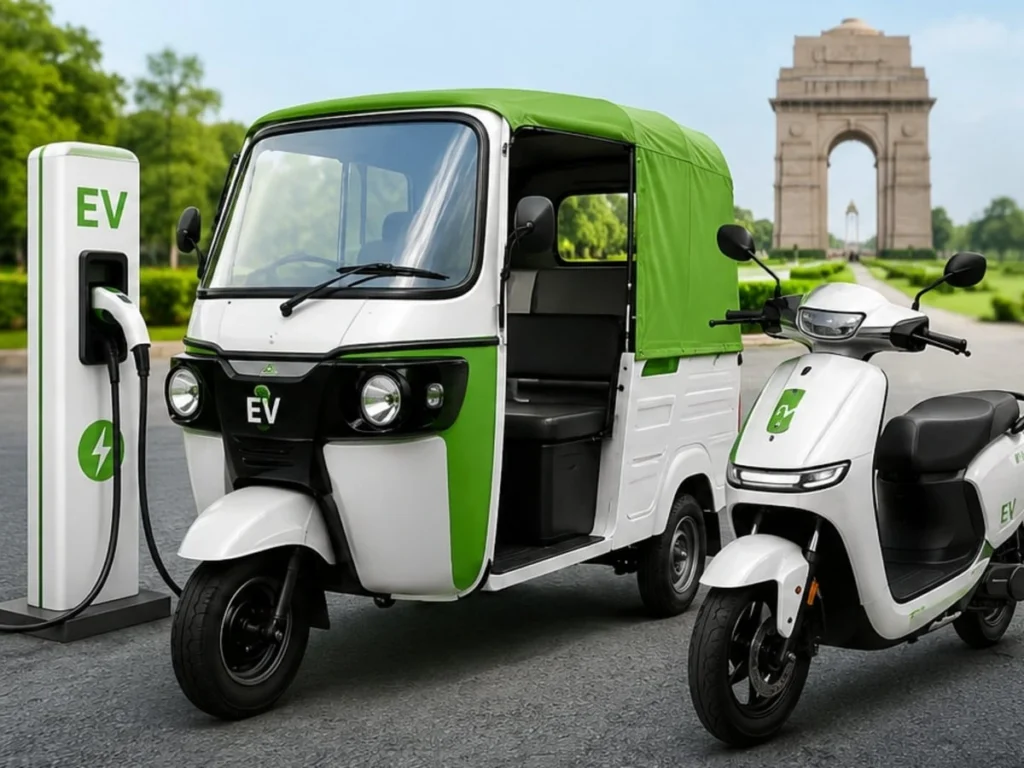
New Delhi: To promote electric vehicles (EVs) in the capital, the Delhi government is preparing to develop a comprehensive and reliable charging network. During a review meeting held on Wednesday, the Chief Minister directed officials to establish a system that ensures easy access to charging facilities for people near their homes and workplaces. He stated that locations such as Delhi Metro parking lots, MCD parking sites, vacant spaces beneath elevated metro corridors, areas around DDA markets, major malls, railway station precincts, government complexes, and large commercial hubs should be identified on a priority basis for the expansion of charging infrastructure.
Target of 32,000 Charging Stations in 4 Years
Senior officials from relevant departments, including Transport Minister Dr. Pankaj Kumar Singh, attended the meeting held at the Delhi Secretariat. During the meeting, the Chief Minister sought detailed information regarding the power supply required for EV charging stations, projected future demand, and the corresponding preparedness of the power infrastructure. He instructed officials to focus specifically on developing solar-powered EV charging stations to promote the use of clean energy. He noted that the Delhi government aims to increase the number of EV charging stations in the capital from the current approximately 9,000 to around 32,000 over the next four years.
Emphasis on Fast-Charging Technology
The Chief Minister stated that transforming Delhi into a modern EV city requires focusing not only on increasing the number of charging stations but also on their quality and amenities. He directed officials to develop new charging stations equipped with seating arrangements, drinking water, and other basic facilities to ensure a better experience for vehicle owners while charging. He also emphasized prioritizing fast-charging technology to meet future needs. Furthermore, he directed that existing slow-charging stations be replaced with fast-charging facilities in a phased manner wherever possible, thereby reducing charging time and enhancing convenience for electric vehicle users. Collaboration with various agencies for charging network expansion
The Chief Minister stated that the active cooperation of various government agencies and relevant institutions would be enlisted to develop an extensive EV charging network in the capital. He mentioned that effective coordination is being established with the Delhi Development Authority (DDA), Delhi Metro Rail Corporation (DMRC), and Original Equipment Manufacturers (OEMs) in this regard. The objective is to accelerate the process of setting up charging stations and ensure the identification of suitable locations.
AI-based pollution monitoring
An AI-based monitoring system will be developed to combat air pollution as part of the Delhi government’s ambitious ‘Clean Air-Healthy Delhi’ project. According to the Environmental and Social Commitment Plan (ESCP) prepared for this ₹8,300-crore project, the initiative will encompass monitoring systems, electric vehicle charging infrastructure, scientific waste management, and a World Bank-supported project management framework.
New flats to be built near Metro and railway corridors
Under the capital’s Transit-Oriented Development (TOD) policy, land situated near Metro, Regional Rapid Transit System (RRTS), and railway corridors will undergo planned development. This initiative aims to promote modern residential and mixed-use developments in close proximity to public transport. In line with this, the Delhi Development Authority (DDA) has initiated the process of inviting online applications from developers for the development of its land parcels located near Metro, RRTS, and railway corridors.
According to the DDA, the application process for private developers and real estate companies under the TOD policy has commenced via the Online Building Permit System (OBPS). The policy seeks to encourage the construction of affordable residential flats near public transport corridors. Additionally, private developers will undertake the development of shopping centers, stadiums, and other public amenities to create a modern and integrated urban infrastructure in these areas. Lieutenant Governor Taranjit Singh Sandhu is regularly reviewing this project and holding continuous meetings with senior officials and concerned departments. The authority stated that a total area of 207 square kilometers has been covered under the TOD policy. Of this, approximately 80 square kilometers have been brought under the policy’s ambit for the first time, a move expected to give fresh impetus to planned, public transport-oriented urban development in the capital.

