


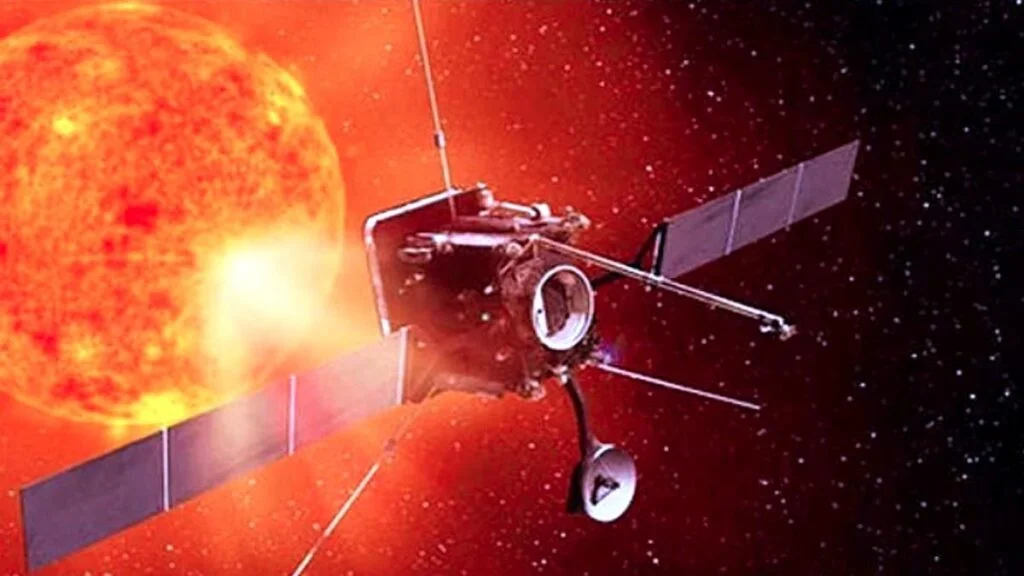
New Delhi: India’s first solar mission, ‘Aditya-L1’, has achieved significant success. The Aditya-L1 spacecraft is uncovering the mysteries of our nearest star. During its first year of operations at Lagrangian Point 1 (L1) in 2024, the Sun was highly active, producing several intense solar flare events. From this unique L1 vantage point, Aditya-L1 has recorded the distinct and unique phenomenon of ‘iron fluorescence’.
What is iron fluorescence?
According to ISRO, when a major solar flare erupts, it heats the Sun’s upper atmosphere (the corona) to extremely high temperatures, triggering a massive burst of high-energy X-rays. While most of these X-rays escape into space, some travel downwards and interact with the Sun’s cooler, denser surface layer, known as the photosphere. Here, they interact with the abundant neutral iron atoms present.
When these coronal X-rays strike the neutral iron atoms, the atoms absorb the energy and emit their characteristic X-ray glow at an energy level of 6.40 keV. This process is known as ‘X-ray fluorescence’. The Solar Low Energy X-ray Spectrometer (SoLEXS) onboard Aditya-L1 is designed to detect X-rays emitted by flares and observe photospheric iron fluorescence triggered by intense flares. The SoLEXS instrument was developed indigenously at ISRO’s U.R. Rao Satellite Centre (URSC).
Understanding solar flares
A study published in the journal Solar Physics indicates that the observed intensity of iron fluorescence depends significantly on the location of the flare on the solar disk—the visible surface of the Sun. Flares occurring near the center of the Sun’s disk exhibit a strong fluorescence signal, whereas the signal was significantly suppressed for flares occurring near the solar limb (edge).
This ‘center-to-limb’ variation aligns with theoretical models. By studying how this efficiency changes, researchers can now utilize iron fluorescence as a potential diagnostic tool to determine the altitude of coronal X-ray sources in the upper solar atmosphere and to investigate the unique viewing geometry of these explosive events.
Why is this discovery by Aditya-L1 significant?
A major aid in understanding the Sun: ‘Iron fluorescence’ will enable scientists to determine how X-rays are generated and propagate within the Sun’s outer atmosphere—the corona—during solar flares.
Study of solar storms: This allows for a more precise study of the altitude, structure, and geometry of solar fluorescence.
Space weather forecasting: Solar storms can impact satellites, GPS, communication systems, and power grids. Such studies can enhance future space weather monitoring capabilities.

