


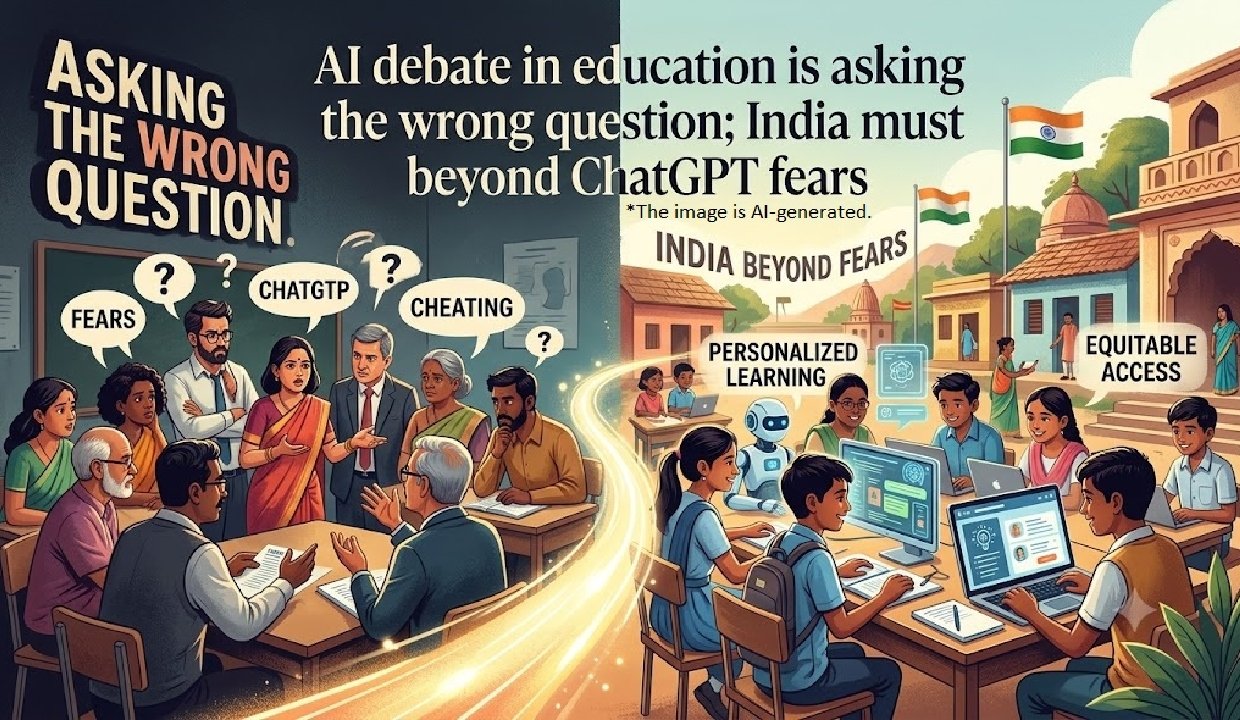
As Artificial Intelligence (AI) rapidly enters classrooms, homes and study routines, the public debate around AI in education has largely focused on one anxiety: is AI making children lazy, dependent or less capable of thinking deeply? In this conversation with The Pioneer, Rohit Kumar Garg speaks about AI, equity, Government schools, and why the real question is not whether AI belongs in education, but which child it is being designed for. An IIT Kharagpur Computer Science product, Garg is an entrepreneur working at the intersection of AI and public education, believes this is an important concern, but an incomplete one. According to him, India must separate two very different conversations: teaching children how to use AI, and using AI to teach children who otherwise have no access to personalised academic support.
Q1. The most common concern parents have today is that AI may make children intellectually lazy. Do you agree?
A: It is a valid concern, but it is not the full picture. For children who already have access to good schools, educated parents, private tutors and learning resources, overdependence on AI is a real risk. If a child uses AI only to skip thinking, write essays without understanding them or get instant answers without struggle, that can weaken learning. But that is one part of India. There is another, much larger India where the problem is not that AI is answering too many questions. The problem is that no one is answering those questions at all. So before asking “Is AI making children lazy?”, we need to ask, “Which children are we talking about?”
Q2. What do you think is missing from India’s current AI-in-education debate?
A: We are mixing up two very different ideas. The first is teaching children to use AI. That includes AI literacy, prompt writing, coding, responsible use and critical thinking around technology. This is important because every child will grow up in a world shaped by AI. The second is using AI to teach children. That means using AI-backed systems to provide personalised, patient, always-available academic support to students who may otherwise never receive one-on-one attention. The first is a skill for tomorrow. The second is a solution for today. India is talking loudly about the first. We are not talking enough about the second.
Q3. Why is personalised attention so central to learning outcomes?
A: Every parent knows this intuitively. When a child is stuck, what changes everything is not always a new textbook or a new classroom. Often, it is one teacher who sits with them, explains patiently, and does not move on until they understand. For decades, this has been the invisible advantage of India’s middle-class and upper-middle-class households. A private teacher, tuition support, an older sibling, or a parent who can help after school. But millions of children in Government schools do not have that safety net. Many are first- generation learners. Many study in crowded classrooms. Many return home to environments where there may be no one who can help them with Science, Maths or English. For these students, personalised teaching is not a luxury. It is the missing foundation.
Q4. So when you say AI can help, you are not talking about AI as a shortcut?
A: Not at all. The worst use of AI in education is to make it an answer machine. The best use is to make it a patient learning companion. A child should not simply receive the answer. The child should be guided towards understanding. The system should identify where the child is stuck, explain the concept differently, ask follow-up questions, and support the student at their pace. The real promise of AI is not that it can replace thinking. The promise is that it can create the conditions in which many more children get to think seriously for the first time.
Q5. What does this mean specifically for Government school students?
A: For a Government school student in a remote district, AI can mean something very different from what it means to an urban child using ChatGPT for homework. It can mean access to a teacher at 10 pm before an exam. It can mean being able to ask the same question five times without embarrassment. It can mean getting help in a subject
where no one at home can support them. It can mean that the child does not have to give up just because the classroom bell has rung. That is a very powerful shift.
Q6. Critics may say technology alone cannot fix education. How do you respond?
A: They are right. Technology alone cannot fix education. But technology can extend the reach of good pedagogy. It can support teachers, not replace them. It can help districts identify learning gaps. It can make academic support available beyond school hours. It can give students continuity. The mistake is to imagine AI as a silver bullet. It is not. But when used thoughtfully, with district ownership, school participation and strong implementation, it can become a very serious public education tool.
Q7. Have you seen evidence that this kind of intervention works?
A: Yes, and some of the most important evidence is coming from Government school systems where we have seen this model operate at district scale. Through programmes like Sampurna Shiksha Kavach in Jharkhand, the core idea has been to give Government school students access to personalised academic support beyond the limits of the classroom. Not as a replacement for school or teachers, but as an additional layer of help for the child who gets stuck after school hours and has no one at home to turn to. The outcomes are worth paying attention to. In Gumla, the Class 12 Science pass percentage rose from 50.2% to 91%. In West Singhbhum, also known as Chaibasa, schools under this intervention recorded an 87.9% pass rate, compared to 73% in non-intervention schools in the same district. At the school level, CM SOE Tatanagar in Chaibasa moved from 25% to 92% in 2026. For me, the significance of these numbers is not just the improvement itself. It is what they reveal about the missing piece in public education.
Q8. Is there a risk that AI will widen inequality instead of reducing it?
A: Absolutely, if access remains unequal. If AI becomes another paid advantage available only to privileged households, it will widen the gap. But if AI-backed teaching is made available through public systems, especially to Government school students, it can do the opposite. This is why the policy question matters.
Q9. What role should teachers play in an AI-enabled education system?
A: Teachers become even more important. AI can handle repetition, immediate support and personalised practice. But teachers bring context, motivation, trust, discipline, emotional intelligence and classroom leadership.
Q10. What should India’s real question on AI and education be?
A: For India, the most powerful use of AI in education may not be teaching privileged children how to prompt better. It may be giving an underserved child, sitting alone with a textbook, the first real chance to ask, understand and continue learning. That is the debate we should be having.

