


Since time immemorial, civilisations have invariably been perceived through the names associated with them. The nomenclature ‘India’ is a term shaped by geography rather than culture, given by outsiders. However, ‘Bharat’ is a timeless name through which this civilization has addressed itself for ages. In a completely decolonized civilisation, Bharat deserves unequivocal primacy over India.
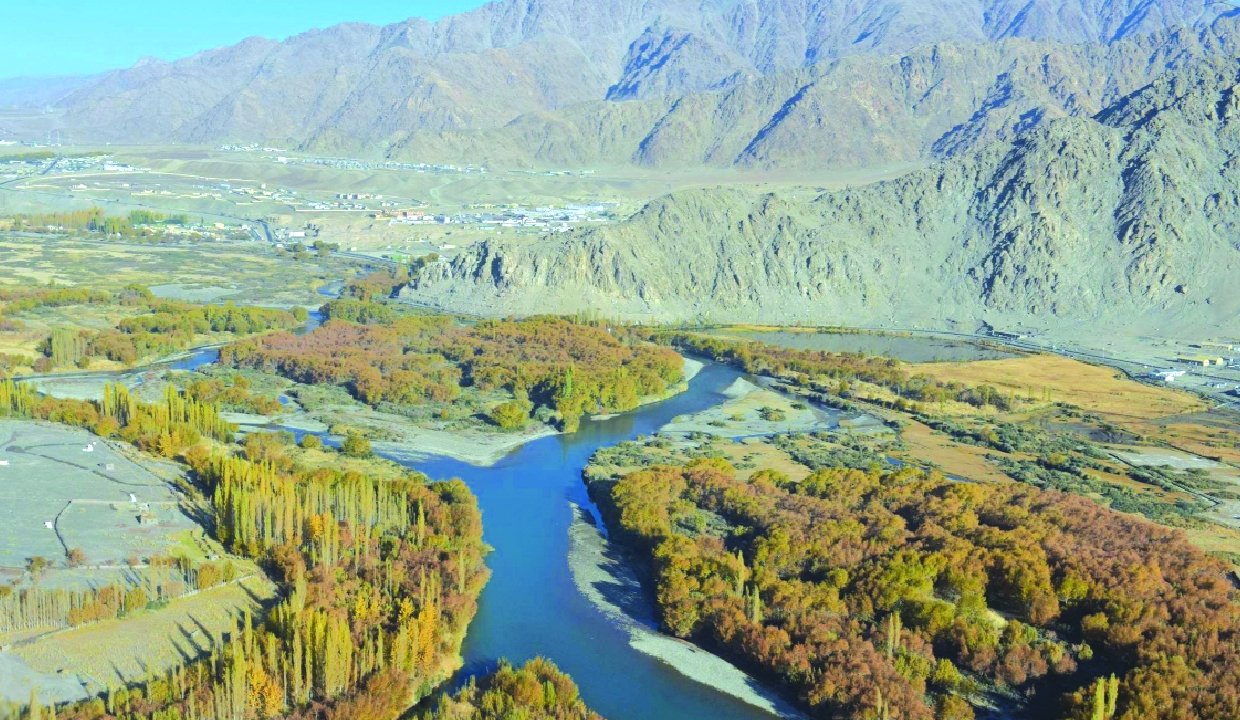
The mighty river Sindhu and the Vedic culture are like conjoined twins, so much so that even the Rig Veda refers to Sapta-Sindhu, the land of seven rivers spread across the north-western subcontinent. In Vedic hymns, Sindhu is synonymous with both the Indus and its wider cultural landscape.
With the eastward expansion of the Achaemenid Persians, Sindhu became Hinduš, depicting the lower Indus basin as an extension of their empire. The Greeks pronounced it Indos and its inhabitants as Indoi — the people of the Indus. Eventually, Indos evolved into ‘India’ in English, while Hindustan came to be used in medieval times.
In other words, ‘India’ is an exonym – a word born in Persian and Greek geographies looking eastward towards a frontier river, rather than a name emerging from the soul of the civilization itself. Over time, colonial cartography stretched this frontier term to cover the entire subcontinent, and post-colonial diplomacy understandably retained it for continuity in treaties, maps and global recognition. However, the etymology is unambiguous — ‘India’ is what others called the land of Sindhu, not what its inhabitants called themselves.
Bharat, however, is not rooted in a foreign ecosystem but in our own polity, history and geography. The Vishnu Purana describes this land, ‘lying to the north of the ocean and to the south of the snowy mountains’, as Bharat, where dwell the descendants of King Bharat. This Bharatvarsha is perceived as a living entity within Jambudvipa and not a colonial landscape depicted on a map by Mercator. Ancient texts remember Bharat as a dutiful and righteous king whose name became synonymous with the land — Bharatvarsha — its inhabitants, Bharatiyas, and the Mahabharata, the tale of Bharat’s descendants.
The framers of our Constitution were aware of this duality, as Article 1 opens with the carefully chiselled phrase, “India, that is Bharat, shall be a Union of States.” Our Constituent Assembly explicitly chose to retain both names — one carrying international familiarity, the other civilisational continuity — as two faces of the same coin. The question now is not whether to delete ‘India’, but whether and how to accord rightful recognition to ‘Bharat’.
This relates to the larger question of decolonization. Recently, when Prime Minister Modi spoke about complete decolonization by 2035, what exactly did he mean? We became independent in 1947 itself, so why speak of decolonization now? In essence, it concerns the larger issue of mental and cultural colonisation, which Macaulay initiated in 1835 through his ‘Minute on Indian Education’, seeking to create “a class of persons Indian in blood and colour, but English in tastes, in opinions, in morals, and in intellect”. This policy systematically imposed Western education as the benchmark of higher knowledge, eroded our time-tested vernacular education systems, and sought to produce ‘clerks’ who would further the cause of the British Raj.
Decolonisation, in this sense, is not about nostalgia. It is about reclaiming intellectual space and cultural self-respect. When a civilisation continues to identify itself through the terminology of its colonizers, it risks living with diminished self-esteem. This is evident even in the comparisons we commonly make. Kalidasa, widely regarded as the greatest poet of ancient India, flourished sometime during the 4th-5th century CE, whereas Shakespeare lived in 16th-17th century England. Yet we still refer to Kalidasa as ‘the Shakespeare of India’. This remains a stark example of the mental and cultural colonialism with which we continue to live.
Following the English system of vowels, we insert ‘a’ into our original words such as ‘Kalidasa’, ‘Bharata’ and ‘Kerala’ (fortunately now often rendered as Keralam), and pronounce them accordingly, distorting Sanskrit and Hindi pronunciations. So much so that we write ‘Yog’ as ‘Yoga’ and pronounce it in the same fashion. The greatest irony is that I am writing this piece in English only to make it more noticeable.
If we take the Prime Minister’s 2035 horizon for eradicating colonial mentality seriously, then nomenclature is not a peripheral issue but part of the mindset that must be revisited. Article 1 already acknowledges both names. However, a logical next step may be to amend the Constitution to place Bharat first, making it “Bharat, that is India, shall be a Union of States”, and to echo this primacy wherever citizens identify themselves.
Such an amendment would allow the Preamble to begin with “We, the people of Bharat…”, aligning our supreme law with a civilisational reality that predates colonial modernity by millennia. Globally, the state may continue to use ‘India’ where necessary for reasons of familiarity and continuity, just as many nations function with multiple official names without legal complexities. However, domestically and constitutionally, the fulcrum would decisively shift from the foreign exonym to our own original endonym. Critics may argue that this is mere symbolism. Yet symbols are what nations are built upon — emblems, flags, songs, anthems and names crystallize the stories we tell about ourselves.
The journey from Sapta-Sindhu to ‘India’ reflects how others mapped us. The journey of Bharat — from the Puranas to the epics, from inscriptions to the Constitution — reflects how we shaped ourselves. As we approach 2035, two hundred years after Macaulay’s project of a decisive mental shift, it is perhaps time to decide which of these paths will anchor the next century of our republic.
Granting unequivocal primacy to Bharat is not about denying history, diversity or global engagement. It is about affirming that this Union of States is fundamentally a civilisational community with its own lineage of thought, its own categories of dignity and, above all, its own ancient name. Perhaps the time has come for both a constitutional and cultural shift to cast off a borrowed identity so that we may proudly live as “We, the people of Bharat” — Bharat, that is India.

