


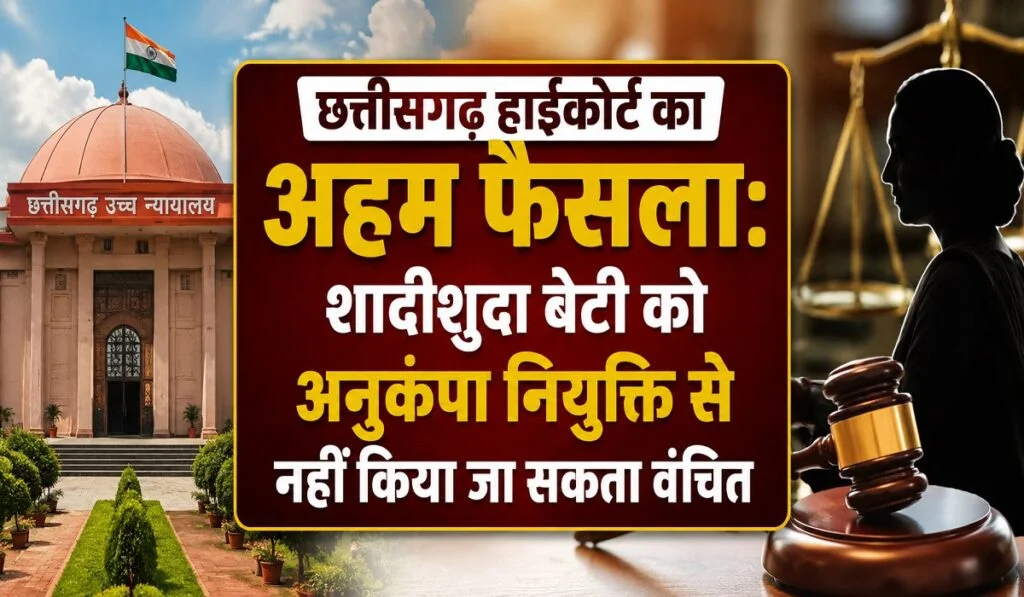
CG High Court: The Chhattisgarh High Court ruled that a married daughter cannot be denied consideration for a compassionate appointment solely on the presumption that she is dependent on her husband. The Court stated that dependency is a question of fact that must be determined based on evidence in each individual case. The Court directed the bank to reconsider her application for compassionate appointment afresh within 30 days, keeping in mind the Supreme Court’s judgment. The Court further observed that marital status, in itself, cannot be a valid ground to exclude a daughter from the scope of compassionate appointment unless the applicable policy explicitly prohibits it.
The petitioner had challenged the rejection of her application for a compassionate appointment following her father’s death; her father had worked as a Deputy Manager at the Bank of Maharashtra. The bank had rejected her claim on the grounds that, being married, she would be deemed dependent on her husband and, therefore, could not be considered a dependent family member of the deceased employee. The petitioner argued that the bank’s policy did not explicitly exclude married daughters and that she was, in fact, financially dependent on her father. Upon examining the bank’s policy on compassionate appointments, the Court found that the definition of “dependent family member” included daughters without making any distinction between married and unmarried daughters.
The Court also noted that the petitioner had specifically stated in her application that she was dependent on her father due to her personal financial circumstances, and the bank had failed to produce any evidence to the contrary. Citing Supreme Court precedents, the High Court held that excluding married daughters based on marital status stems from gender stereotypes that are unconstitutional and violate Articles 14 and 15(1) of the Constitution. The High Court stated that a daughter cannot be excluded solely on the ground of being married. This is clearly arbitrary.

