


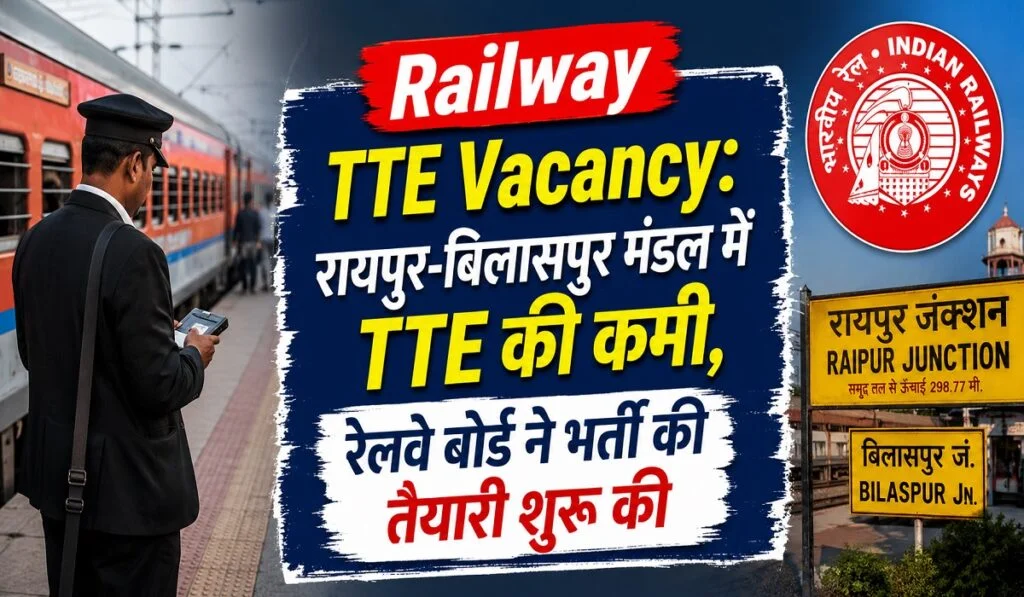
Railway TTE Vacancy: The Railway Board has sought comprehensive details regarding TTE (Travelling Ticket Examiner) staff from the zones. Based on this report, future recruitment of TTEs will be conducted according to vacancies and operational requirements. Information has been gathered from the Raipur, Bilaspur, and Nagpur divisions. This data collection aims to strengthen the ticket-checking system within Indian Railways, as the number of trains in the zone—beyond just the Raipur division—is steadily increasing. Furthermore, dozens of special trains are operated during festivals and the summer season; consequently, the shortage of TTEs hinders regular ticket inspections. The Railway Board has instructed all zones to submit data in a prescribed format covering currently employed TTEs, sanctioned posts, vacancies, and projected staffing requirements for August 1, 2026, and August 1, 2027. The report will also factor in new trains, operational expansions, and established manning standards. Based on the data received from all zones, the Railway Board will formulate a consolidated manpower plan for the entire railway network.
Railways periodically conduct ticket-checking drives to take action against passengers traveling without tickets or with irregular tickets. However, these campaigns are sporadic due to the limited number of TTEs. Railway officials believe that this review could pave the way for future recruitment against vacancies and manpower restructuring, potentially leading to improvements in the ticket-checking system and passenger amenities. According to information from the Railways, the Raipur division currently has 250 TTEs, while over 140 trains operate from the division. During festivals, the number of trains and trips increases, and passenger volume exceeds one lakh; given this, the current number of TTEs is considered insufficient.
The shortage of TTEs directly impacts the ticket-checking system. While the Railways periodically conducts special ticket-checking drives to penalize passengers traveling without tickets or with irregular tickets, such campaigns cannot be carried out regularly due to limited staff. If sufficient TTEs are available, continuous ticket checking on trains will be possible, and railway revenue could also increase.

