


Success Story: Children are seated in the classroom, with teacher Khushbu Kumari standing before them. The children hold neither books nor notebooks; instead, Khushbu uses her hands and fingers to explain Hindi vowel markers (matras). She performs an action, and the children observe and mimic it. While some join in immediately, others require a second explanation. This is Khushbu’s teaching style. Rather than relying solely on textbooks to explain every lesson, she strives to help children understand concepts through observation, hands-on activity, or play. Sometimes her fingers become tools for teaching multiplication tables, while at other times, body parts themselves serve as Teaching-Learning Material (TLM).
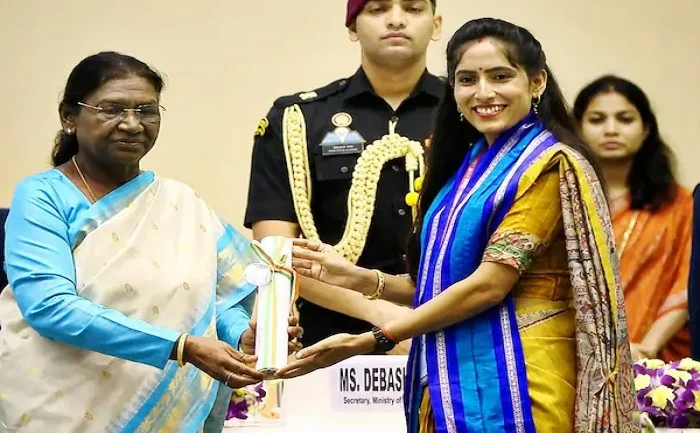
For Khushbu Kumari, Head Teacher at Urdu Primary School Bidaydih in Banka, Bihar, this is not a mere demonstration but a part of her daily classroom routine. Through this teaching method, she has built a bond of trust with her students and witnessed a positive shift in school attendance. Her work has now gained national recognition; she was honored with the National Teachers’ Award by President Droupadi Murmu. Upon her return to Bihar, she was also felicitated by Education Minister Mithilesh Tiwari.
Changing the Teaching Method, Not the Curriculum
Khushbu began her teaching journey in 2013 at the Upgraded Middle School Kathoun in the Katoria block of Banka district. She soon realized that not all children in the classroom learn in the same way. Consequently, she adopted a new teaching style. She did not alter the syllabus but transformed her pedagogical approach. She used fingers to teach multiplication tables, incorporated physical movements to explain Hindi vowel markers, and integrated games and songs into the classroom experience. It began with small experiments, and as she achieved success, she expanded upon these methods.
When the Body Itself Becomes the TLM
In Khushbu’s classroom, teaching aids are not always charts or models. Often, the simplest available resources—such as the children’s hands, fingers, or bodily movements—serve the purpose effectively. For instance, teaching multiplication tables using fingers is one such example. She also employs various activities to teach Hindi vowel markers (matras). Furthermore, children are actively engaged in the classroom through games and songs. This entire process fosters dialogue between the teacher and the students, making the learning experience enjoyable.
From ‘Chahak’ to the Camera
After joining the ‘Chahak’ program in 2022, Khushbu began recording videos of her classroom activities. Initially, these videos served merely as a way to document her own teaching experiments and were shared within a group comprising parents, fellow teachers, and officials. Over time, however, social media helped her reach a much wider audience.
Gradually, people began responding to her videos. Her popularity on social media grew, and her innovative teaching methods extended beyond the confines of the school classroom.
‘Good Touch-Bad Touch’ Expanded Her Reach
Among the videos Khushbu created, the one addressing child safety—specifically the concept of ‘Good Touch-Bad Touch’—became particularly popular. In it, she explained—in simple language—important concepts such as bodily autonomy and the need to speak to a trusted adult if one feels uncomfortable. The video went viral on social media, bringing her work on child safety and awareness to a broad audience. This specific video gained immense popularity because it addressed a significant societal issue—one that people often hesitate to discuss openly—despite the fact that everyone is concerned about such safety.
Winning Trust in Bidaydih Was a Challenge
On July 21, 2025, Khushbu was posted as the Head Teacher at the Urdu Primary School in Bidaydih, Banka. A large number of students at the school came from Muslim families. However, the challenge she faced at this new school went beyond merely improving academic standards; it was also crucial to establish a rapport and build a relationship of trust with the children and their families.
Yet, Khushbu did not view this through the lens of community-specific issues. For her, the real challenge lay in connecting with the students and their families. They interacted with parents, spent time with the children, and gradually established a dialogue between the school and the families. Over time, the bond between the children, parents, and the school strengthened; consequently, a change was observed in school attendance as well.

