


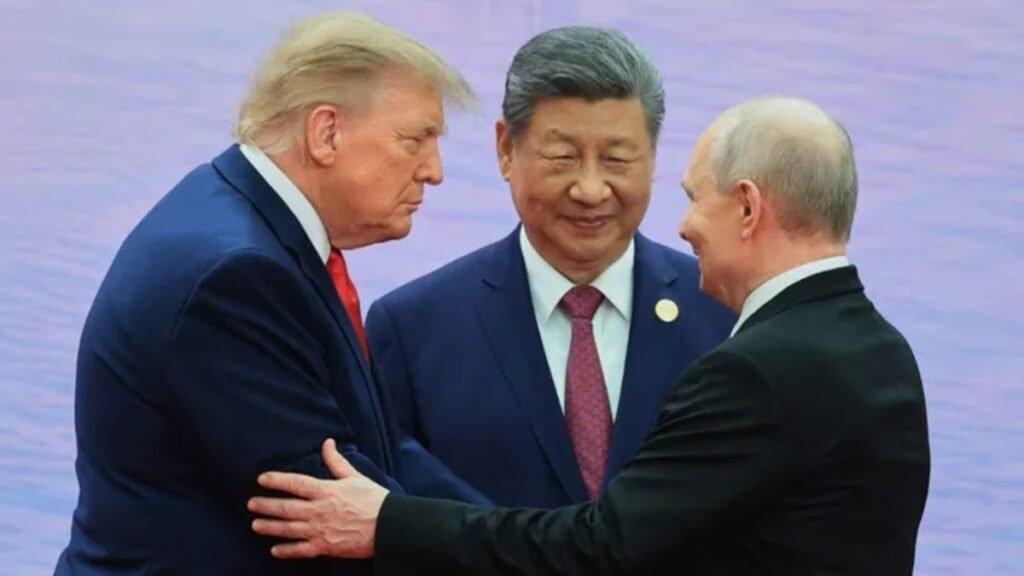
Beijing: A major shift could be on the horizon in global politics. U.S. President Donald Trump, Chinese President Xi Jinping, and Russian President Vladimir Putin are set to participate in a historic trilateral meeting. Taking place in Shenzhen, this encounter comes at a time when the world is grappling with multiple wars, a nuclear arms race, and economic tensions. The meeting has generated significant international discussion, with some even drawing comparisons to the historic 1945 Yalta Conference.
Why is the meeting between Trump, Xi, and Putin significant?
The importance of this meeting—proposed on the sidelines of the Asia-Pacific Economic Cooperation (APEC) summit—stems from the fact that it brings together the leaders of the world’s three major powers for direct dialogue.
Currently, the nuclear arms control framework between the United States and Russia has weakened. Meanwhile, ongoing conflicts in Ukraine and Iran, trade disputes between the U.S. and China, and intensifying competition in Artificial Intelligence (AI) have further complicated the global landscape.
U.S. President Donald Trump views this meeting as an opportunity to explore potential paths toward nuclear arms control and the resolution of the conflicts in Ukraine and Iran. However, given the distinct strategic interests of the three nations, the likelihood of reaching a major agreement remains low for now.
Why is it being compared to the 1945 Yalta Conference?
This meeting is being compared to the Yalta Conference, which took place during the Second World War. In February 1945, U.S. President Franklin D. Roosevelt, Soviet leader Joseph Stalin, and British Prime Minister Winston Churchill gathered in Crimea.
That conference addressed the future of Europe following the defeat of Nazi Germany, the partition of Germany, the establishment of the United Nations, and the post-war global order.
However, the circumstances surrounding the meeting in Shenzhen are entirely different. At Yalta, the three Allied powers were determining the post-war order; in contrast, today, nations like the United States, Russia, and China are strategic rivals across several domains.
This is precisely why this meeting is considered highly significant in the context of global politics.
Nuclear Arms Control: The Greatest Challenge
The issue of nuclear weapons is expected to be the most critical topic at the meeting. The ‘New START’ treaty—the last major agreement governing nuclear arms between the United States and Russia—is set to expire in February 2026.
This treaty established limits on the strategic nuclear arsenals of both nations, as well as the delivery systems used to deploy them. It also provided a framework for monitoring and ensuring transparency regarding these weapons.
Donald Trump has expressed a desire to include China in any future nuclear agreement. However, China is not receptive to this proposal.
Estimates suggest that China possesses over 600 nuclear warheads, while the United States and Russia hold significantly larger stockpiles. Consequently, China fears that accepting similar restrictions could limit its ability to expand its own nuclear capabilities.
Discussions on Ukraine and Iran
The conflicts in Ukraine and Iran are also likely to be addressed during this trilateral meeting.
According to Yuri Ushakov, a foreign policy advisor to Russian President Vladimir Putin, the war in Ukraine may be raised. For Russia, this represents a key opportunity for direct engagement with both the United States and China.
Since its invasion of Ukraine in 2022, Russia has faced stringent sanctions from Western nations. Meanwhile, China has maintained its economic ties with Russia, providing Moscow with vital support amidst pressure from the West.
Furthermore, the situation involving Iran could also emerge as a point of contention among the three nations. The United States has taken military action against Iran, while China and Russia maintain economic and strategic ties with Tehran.
A significant question is why directly affected nations—such as Ukraine and Iran—are not part of these trilateral discussions. Consequently, the stability of any agreement reached without the participation of these countries could be called into question.
The personal relationships between Trump, Xi, and Putin will also be put to the test.
Donald Trump has frequently asserted that his personal rapport with major world leaders can prove beneficial in international diplomacy.
Ahead of the meeting, the interaction between Xi Jinping and Trump drew attention; the two leaders greeted each other and shook hands.
Meanwhile, a strong relationship is also evident between Xi Jinping and Vladimir Putin, with both leaders having referred to each other as “old friends.”
Ties between China and Russia—spanning trade, energy, military cooperation, and diplomacy—have steadily strengthened. Both nations have consistently sought to challenge the influence of Western powers within the international order.
However, despite these positive personal relationships, resolving differences rooted in national interests will not be easy.
US-China trade tensions and competition in AI are also critical factors.
Beyond security and military matters, economic and technological rivalry between the US and China is likely to be a key component of the discussions.
The two nations remain at odds over issues such as tariffs, rare earth minerals, advanced semiconductors, and artificial intelligence.
The US is attempting to restrict China’s access to advanced semiconductor technology, while China is focused on strengthening its domestic chip industry and reducing its reliance on American technology.

