


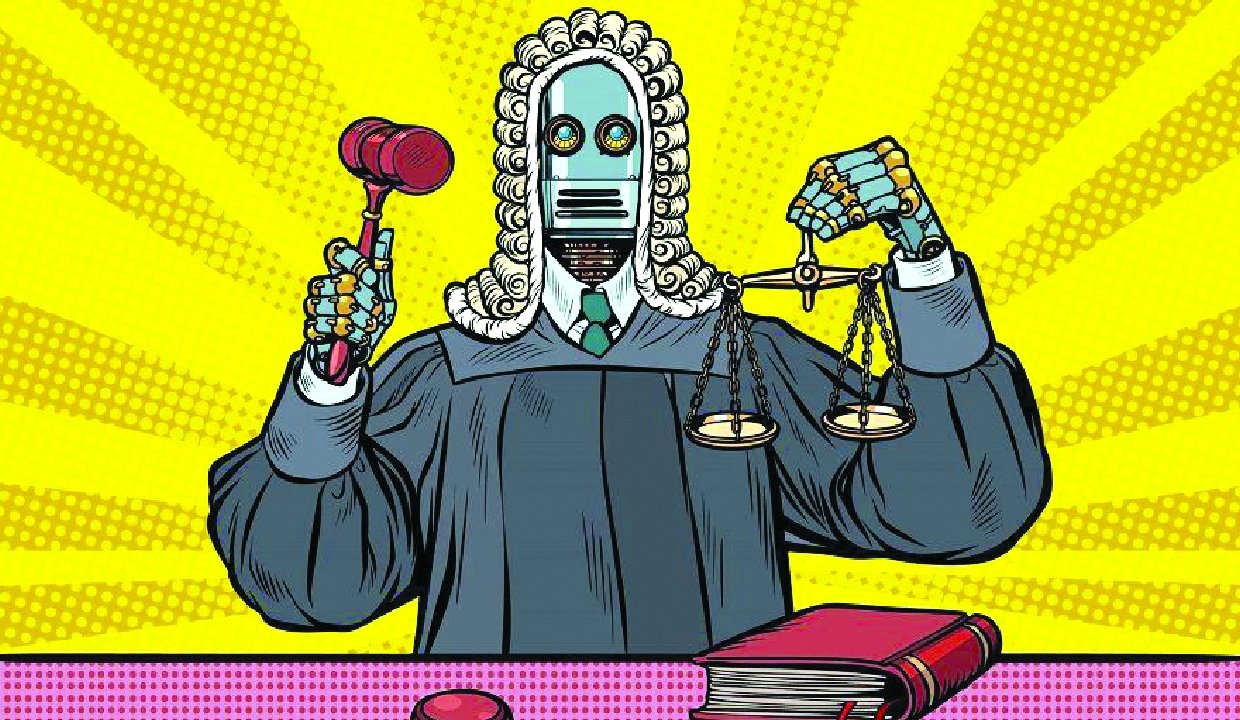
Supreme Court bans AI for judges: Why the public is still trapped in the machine
Washington, DC — India is entering a technological utopia. In the first half of 2026, a wave of capital has flooded our tech sector. The government just announced a $1.1 billion venture fund for AI. The Adani Group has committed $100 billion to build AI data centres. Planning started for Smart Borders, Blackstone just dropped $600 million on a single Indian AI startup, Neysa.
But if you look closely at what these billions of dollars are actually building, a much darker picture emerges.
In a nicely written book of year 2018, Automating Inequality, Virginia Eubanks warned us that when massive institutions digitise, they don’t democratise. Instead, they build a “digital poorhouse” — a system where the wealthy use technology to make their lives easier, while the working class is managed, and denied essential services by algorithms.
Eight years later, Eubanks’ warning isn’t just coming true. It is the foundational business model of the 2026 Indian tech boom. We aren’t funding a utopian future; we are funding the mass automation of the middle and lower classes. We are building a new socioeconomic divide where human empathy, and attention are entirely eradicated for the public, and reserved exclusively as a luxury good for the rich.
The Supreme Court’s Accidental Confession
If you want undeniable proof of this emerging class system, look no further than the preliminary draft of the Regulations for Use of Artificial Intelligence in Courts, 2026, released just days ago on June 3 by the Supreme Court of India.
It is a piece of regulatory foresight. The apex court explicitly banned the use of AI for determining judicial outcomes, bail eligibility, or sentencing.
They specifically prohibited the use of “black-box” risk-scoring algorithms. The mandate is clear: AI must remain strictly subservient to human judgment. The court recognized a truth — human lives are too messy, context is too vital, and justice is too complex to be outsourced to code.
The judges are entirely right. But their ruling exposes a maddening hypocrisy.
The highest echelons of power just legally protected themselves, and the citizens fortunate enough to reach their courtrooms, from the unfeeling judgment of the machine. Yet, outside the halls of the Supreme Court, those exact same “black-box” algorithms —fuelled by this new wave of billion-dollar venture funding — are currently running wild through the daily lives of the Indian public.
Why is human context a fundamental legal right in a bail hearing, but an unaffordable luxury when an enterprise AI system filters your resume, denies your health insurance claim, or rejects your micro-loan? When a human bank manager says no, you can plead your case, provide context, or point out a clerical error. When an algorithm says no, you are simply rejected by an invisible math equation.
The elite have legally protected themselves from the machine. The rest of the country is being pushed inside it.
The End of the ‘Hold Music’ Era
Venture capital does not flow to democratise society; it flows to maximize efficiency. And in corporate India today, the greatest “efficiency” to be gained is the total eradication of human payroll.
We are currently witnessing the death of human-to-human corporate interaction. For years, consumers complained about the frustration of sitting on hold for forty-five minutes just to dispute a fraudulent bank charge or fix a delayed flight. Very soon, we are going to miss the hold music.
The startups currently digesting hundreds of millions in funding are not building tools to help you. They are building digital moats for mega-corporations. The enterprise chatbots of 2026 are impeccably polite, grammatically perfect, and functionally useless for edge cases. They are programmed to simulate empathy while protecting the company’s bottom line. They will apologise for your broken product in a dozen different lyrical variations, but they will not authorise your refund.
The cost of human labor is high, and the cost of AI compute is plunging toward zero. For a telecom giant or a massive e-commerce platform, the goal is no longer customer service. The goal is to make reaching a human employee so exhausting, so labyrinthine, and so frustrating that the consumer simply gives up. We are digitising apathy. Corporations are using their newly funded AI not to solve our problems, but to scale their own indifference to infinite proportions.
‘Human’ is the New Organic
To understand exactly how this new class divide will look, we only need to look at what happened to the global food industry over the last century. Decades ago, heavily processed, scientifically optimized food was marketed as a modern miracle. It was cheap, it was efficient, and it fed the masses. Fast forward to today, and the script has completely flipped. Processed, mass-produced food is the default diet of the working class, while the wealthy pay astronomical premiums for food that is “organic,” “hand-picked,” and “farm-to-table.”
Industrialisation made the artificial cheap, which inherently made the natural a luxury. AI is simply the industrialisation of thought. It is processed intelligence.
In the very near future, these highly funded AI services will be pushed onto the public as a great equaliser. On the surface, it will look like progress. But it will be a hollowed-out version of the services the wealthy receive. An AI tutor will never recognise that a student is failing because they are hungry or being bullied at home. An AI therapist will dispense perfectly optimised cognitive behavioural prompts, but it will never actually care if the patient lives or dies.
Meanwhile, the wealthy will opt out. They will send their children to screen-free schools with human teachers. They will consult human doctors who have the time to listen to their fears. They will hire human wealth managers who understand the subtle art of negotiation.
The phrase “Talk to a real person” is changing from a basic consumer expectation into a premium subscription tier. The ultimate status symbol in 2028 won’t be a sports car; it will be a company guaranteeing an “Artisanal Human Experience” — a real expert whose time you can actually afford to buy.
The Right to a Human
As we celebrate the billions dollars flowing into data centers, we must ask: efficiency for whom? When welfare benefits, identity verification, and municipal complaints are entirely automated, the vulnerable fall through the cracks. Eubanks warned us that technology allows institutions to hide their cruelty behind a veneer of objective math.
We don’t just need regulations that demand tech platforms delete deepfakes in three hours. We don’t just need the Supreme Court to exempt itself from AI judgments. We need protections for the everyday consumer who is currently in the crosshairs of this massive funding boom. If a machine denies you a job, terminates your insurance, flags your tax return, or rejects your Government benefits, you must have the legal right to force a human being to look you in the eye and explain why. We need to legally enshrine a “Right to a Human” before the architecture of this new class system hardens permanently.
Tech billionaires love to tell us that their AI models will elevate humanity. But if we aren’t careful, humanity itself will become just another luxury good — priced out of reach for everyone except those who can afford the artisanal experience of being treated like a person.

