


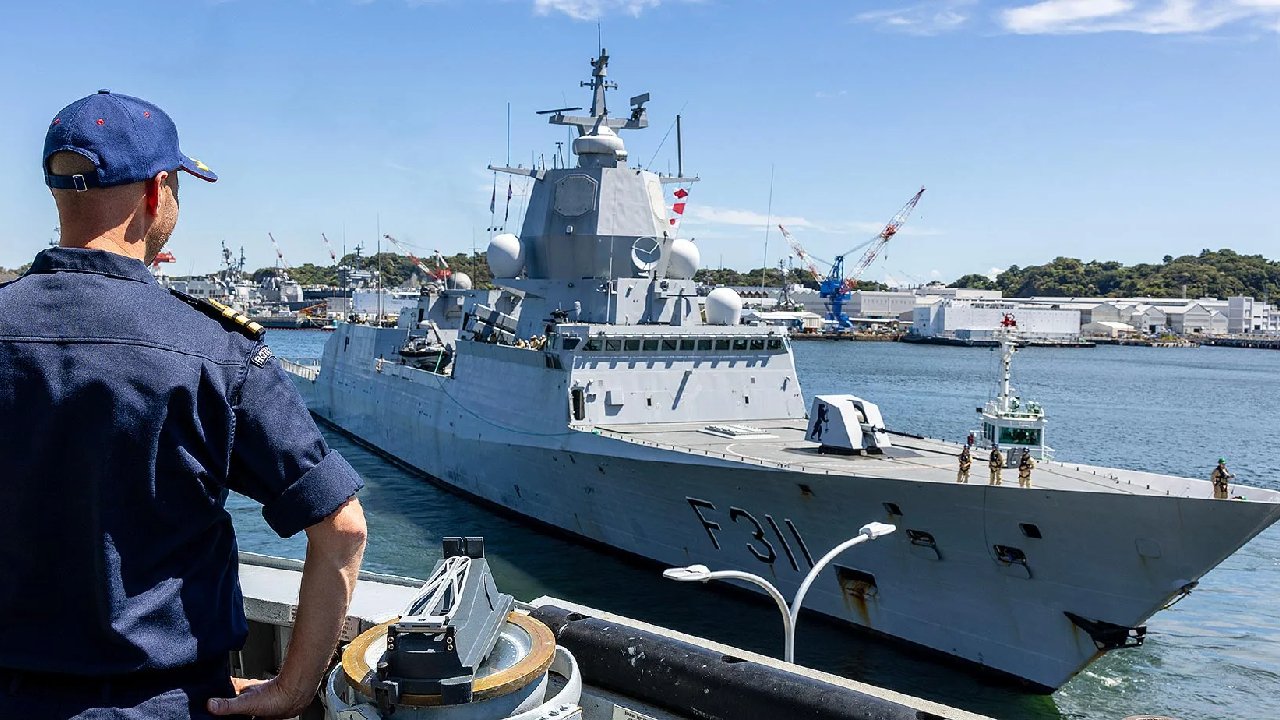
Naval exercise organized by South Africa under BRICS PLUS name in January 2026 has generated domestic and international controversies. Additionally, it brought Indian presidency of BRICS Plus under watchful eyes of the Trump administration.
As reported by South African and international media outlets, Pretoria recently hosted a week-long naval exercise involving several BRICS-Plus members from 9 to 16 January, titled “Will for Peace 2026.” The drill was initiated by South Africa and reportedly led operationally by China. Participating navies included South Africa, China, Russia, the UAE and Iran, while countries such as Brazil, Egypt and Ethiopia were present only as observers.
India chose not to participate, maintaining that the exercise was not the outcome of any institutional BRICS-Plus decision but rather a unilateral initiative by the host country. Indian officials have also indicated that New Delhi has generally refrained from joining such military activities under the BRICS rubric in the past.
The exercise nonetheless generated controversy, particularly because of Iran’s involvement. Public statements from the US administration, as reported in the press, raised concerns about Tehran’s participation against the backdrop of continuing domestic unrest and allegations of human-rights violations inside Iran. The US Embassy in South Africa is said to have formally conveyed its apprehensions regarding the drill.
South African domestic reporting further suggested that President Cyril Ramaphosa subsequently sought the withdrawal of Iran’s invitation, although indications are that this directive was not implemented by the country’s naval command. Iran ultimately took part with three vessels. These developments prompted debate within South Africa itself, with opposition figures and commentators questioning civil–military coordination and presidential authority. The government has since announced that a formal inquiry would examine how the decision-making process unfolded.
Internationally, the optics of the exercise also attracted attention. With India declining to join and Brazil remaining an observer, several analysts have argued that the composition of the active participants—particularly China, Russia, South Africa and Iran—was bound to invite geopolitical interpretation. In Washington and some Western capitals, the drill appears to have been viewed through the prism of existing strategic rivalry, with some observers portraying it as an implicit counter-signal to US-led maritime cooperation in the Indian Ocean.
India’s position has been relatively consistent: New Delhi continues to emphasise that BRICS is primarily an economic and developmental grouping rather than a military or security alliance. At the same time, India remains a key member of the Quadrilateral Security Dialogue (Quad) alongside the United States, Japan and Australia—a forum widely perceived as aimed at promoting maritime stability and balancing China’s growing footprint in the Indo-Pacific. From this perspective, India’s absence from the South African-hosted exercise may be read less as a rebuke to BRICS partners and more as an effort to avoid militarising the grouping.
Still, perceptions matter in international politics. Because the drill was led by China and included Russia and Iran, some analysts have interpreted it as reinforcing Western concerns that parts of BRICS-Plus could be drifting toward an overtly geopolitical posture. Beijing and Moscow, for their part, have repeatedly rejected such characterisations, while BRICS members collectively insist the grouping is not directed against any country or bloc.
These sensitivities take on added significance for India because New Delhi currently holds the BRICS presidency. As chair, India is expected to convene multiple ministerial meetings and summits and to shape the agenda across economic, development and institutional cooperation. The controversy surrounding the naval exercise—and especially Washington’s reported objections to Iran’s participation—suggests that future BRICS-Plus initiatives may be scrutinised more closely than before.
The Trump administration has previously expressed scepticism about BRICS, portraying it as potentially hostile to Western interests and focused on alternatives to the dollar-dominated financial system. India has sought to distance itself from overt “de-dollarisation” campaigns even while promoting greater use of the rupee in bilateral trade. Yet the presence of Iran in a BRICS-linked naval drill has arguably given fresh ammunition to critics who view the grouping, particularly under Chinese and Russian influence, as drifting toward an anti-Western posture.
For New Delhi, this creates a delicate diplomatic challenge. On one hand, India has an interest in preserving BRICS as a pragmatic platform for development finance, Global South coordination and economic reform. On the other, it must manage relations with the United States, which will likely watch India’s stewardship of BRICS far more closely during this presidency—especially in areas that stray into security signalling.
Complicating matters further is India’s own relationship with Iran, a long-standing partner in energy and connectivity projects. Any attempt to marginalise Tehran within BRICS-Plus could prove awkward, particularly at a time when US–Iran tensions remain high and regional escalation cannot be ruled out. How India navigates these cross-currents—keeping BRICS focused on economics while avoiding the impression that the forum is evolving into a strategic bloc—may become one of the defining tests of its chairmanship.
In that sense, the South African naval exercise may prove less important for what actually occurred at sea than for the diplomatic ripples it has created. With India now firmly in the BRICS spotlight, indications are that every initiative under its presidency will be assessed not only by fellow members, but also by a watchful Washington eager to see whether New Delhi can prevent the grouping from being cast—fairly or otherwise—as an anti-American or anti-Western platform.

