


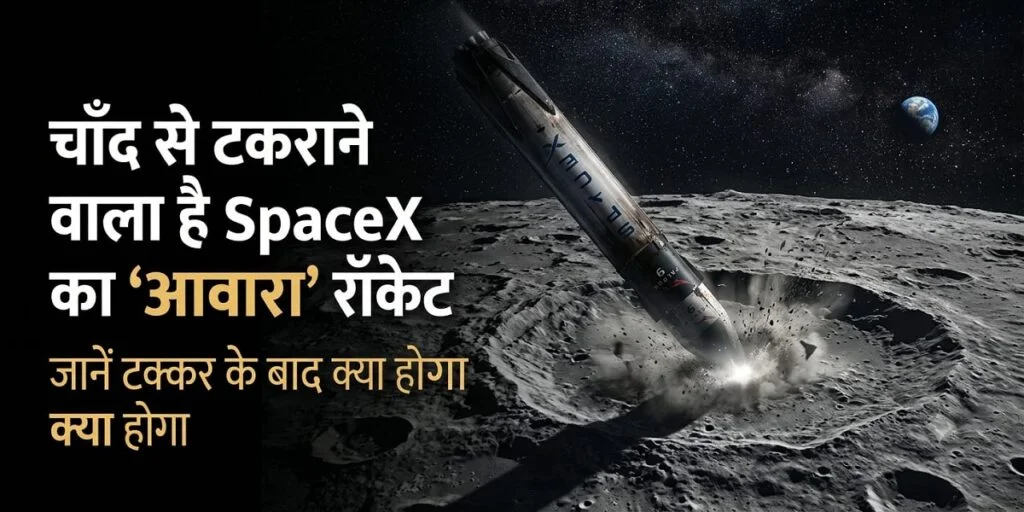
Moon Rocket Crash: An old SpaceX rocket drifting in space is set to collide with the Moon in the coming days. This ‘rogue’ rocket became spent after delivering two lunar landers into space over a year ago and is now drifting on a trajectory that will see it crash into the lunar surface. According to scientists, the rocket’s upper stage will impact near the Einstein Crater on the Moon’s western side. The collision will be powerful enough to create a large crater on the lunar surface and send a massive plume of dust and rock debris into space.
Collision at 8,700 km/h
Space tracking expert Bill Gray estimates that the rocket will strike the Moon at a speed of approximately 5,400 miles per hour (about 8,700 kilometers per hour). This speed is roughly seven times faster than the speed of sound. The event will occur on the sunlit side of the Moon. Scientists suggest that the best viewing opportunities will be from the eastern parts of the US and Canada, as well as various regions of South America. However, since the impact will take place during the early hours of the night and the resulting flash may be faint, direct observation could prove difficult.
Plume of dust and debris to spread for kilometers
Experts state that the debris resulting from the impact could spread for several kilometers into space and remain visible through telescopes for several minutes. Benjamin Fernando, a scientist at Los Alamos National Laboratory, noted that the Moon has low gravity and no atmosphere; consequently, there are no processes to disperse the dust or carry it away.
90-foot-wide and 16-foot-deep crater to form
Fernando estimates that the impact could create a crater on the lunar surface approximately 90 feet (27 meters) wide and 16 feet (5 meters) deep. Although this crater will not be visible from Earth, spacecraft orbiting the Moon will be able to easily record it. NASA’s Lunar Reconnaissance Orbiter and South Korea’s Danuri Lunar Orbiter will capture images of the event both before and after the impact. According to scientists, Danuri will pass within one or two miles of the rocket about two minutes before the collision.
Rocket Delivered Two Moon Landers to Space
This section of the rocket is approximately 40 feet (12 meters) long and weighs around 4,500 kilograms. It was used on January 15, 2025, to launch two private moon landers into space. One of these was Firefly Aerospace’s “Blue Ghost,” which achieved the first-ever fully successful lunar landing by a private spacecraft. The second lander belonged to the Japanese company ispace but crashed during its attempt to land on the Moon.
Has Such an Event Occurred Before?
Scientists note that while natural meteorite impacts cannot be predicted in advance, controlled impacts involving human-made objects can be studied. This is not the first time a defunct rocket will collide with the Moon. In 2022, a piece of a Chinese rocket crashed onto the far side of the Moon, creating two craters. NASA also intentionally crashed rocket stages and lunar modules onto the Moon during the Apollo missions to conduct seismic studies. In 2009, as part of the LCROSS mission, NASA crashed its spacecraft and a rocket stage near the Moon’s south pole to detect the presence of ice.

