


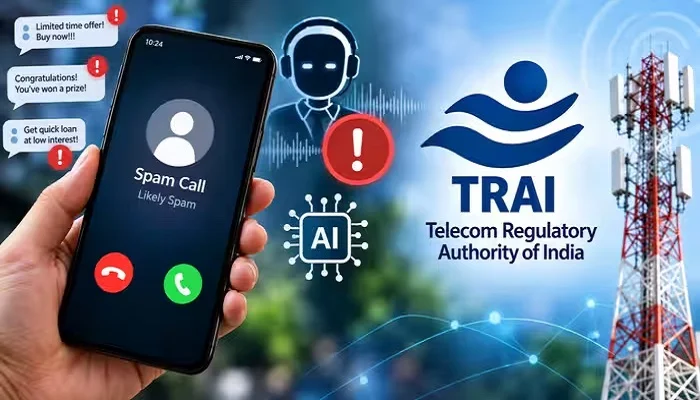
New Delhi: The Telecom Regulatory Authority of India (TRAI) has amended regulations to address the concerns of mobile users plagued by spam calls and unwanted commercial calls. Under the new rules, telecom companies will now identify potential spam numbers using AI and machine learning-based systems. Provisions have also been made to share information regarding such numbers among different telecom companies.
According to TRAI’s new regulations, if five or more mobile numbers linked to a single sender are flagged as suspected spam within a 10-day period, the sender may face further investigation. Investigative measures could include re-verification of KYC (Know Your Customer), physical verification, and the suspension of outgoing services. Repeated violations could even lead to the disconnection of telecom services.
Spam numbers to be identified via AI and Machine Learning
Under the new system, telecom companies will utilize AI and machine learning technologies to identify mobile numbers likely to be used for spam or unwanted commercial calls. Information regarding suspicious numbers can be shared with other telecom operators, enabling comprehensive monitoring of spam activities.
New rules for Automated Calls and Robocalls
TRAI has also established regulations concerning automated calls and robocalls. Calls made via apps, software, auto-dialers, or other automated platforms—rather than by a person manually dialing a number—will fall under the purview of this system. This includes calls featuring pre-recorded audio or artificial voices.
Companies or entities making such calls must inform their telecom operator in advance. Additionally, they are required to provide the operator with details regarding the numbers used for A2P (Application-to-Person) calls.
Failure to provide information could classify calls as UCC
If an entity fails to inform the telecom operator about A2P calls in advance, such calls may be classified as Unsolicited Commercial Communication (UCC). Additionally, a termination charge of up to 5 paise per minute will be levied on certain A2P calls.
However, calls originating from specific numbering series designated by TRAI and those approved by the authority are exempt from this charge.
Directives regarding calls from the 140xx and 1600xx series
The new regulations prohibit call management apps from automatically blocking or filtering calls originating from specific numbering series—such as 140xx, 1600xx, and 1601xx—solely based on the number series itself.
These numbering series are used for regulated commercial and government communications. TRAI aims to ensure that legitimate government or business calls are not automatically blocked or hidden by being misidentified as spam simply due to their numbering series.
However, if a user does not wish to receive calls from a specific number, they retain the option to block that number individually.
The primary objective of these new TRAI provisions is to strengthen oversight of spam and unsolicited commercial calls, establish accountability for automated calling, and prevent legitimate government and business communications from being erroneously filtered as spam.

