


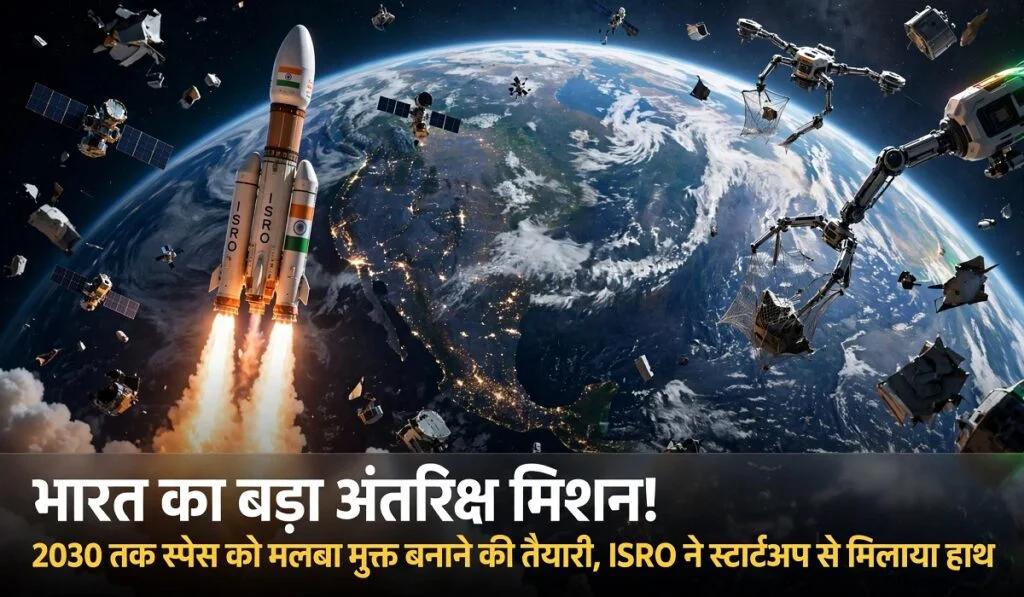
New Delhi. India has taken a major initiative to address the growing problem of space debris in Earth’s orbit. The central government has set a goal to make Indian space activities ‘debris-free’ by the year 2030. Under this ‘Clean Space Mission,’ efforts will be directed toward reducing existing space debris and preventing the creation of new debris in the future. This ambitious vision was announced by the Union Minister of State for Science and Technology, Dr. Jitendra Singh.
The Indian Space Research Organisation (ISRO), alongside private sector companies, will play a crucial role in this mission. The objective is to make space safer and more sustainable, thereby mitigating the risks posed by debris to future satellite missions and scientific endeavors.
Making space activities debris-free by 2030
Under the ‘Debris-Free Space Mission’ (DFSM), the central government has set a target to prevent the generation of any new debris from Indian space missions by 2030. According to Dr. Jitendra Singh, India is developing the necessary technologies and capabilities to reduce the threat posed by existing space debris. This initiative reflects both India’s growing technical prowess in the space sector and its commitment to global space security.
In reality, the number of satellites in Earth’s orbit is steadily increasing. Large satellite networks, such as Starlink and OneWeb, have significantly intensified activities in space. Concurrently, the accumulation of defunct satellites, rocket components, and other fragmented equipment has become a major challenge.
Millions of pieces of debris exist in space
Concerns regarding space debris are mounting. According to available data, there are over 100 million (10 crore) pieces of man-made debris—ranging from small to large—in Earth’s orbit. Many of these objects are traveling at speeds exceeding 25,000 kilometers per hour. Due to such high speeds, even a small piece of debris can cause severe damage to an active satellite.
According to NASA data, there are approximately 50,000 large objects in Earth’s orbit that can be tracked. Meanwhile, the U.S. Space Surveillance Network had cataloged over 34,000 objects as of August 2026. These include active and defunct satellites, as well as remnants of rockets.
India’s share of global space debris is less than 1 percent.
Government data indicates that there are 129 trackable debris objects in space associated with India. This includes 23 defunct satellites—some in Low Earth Orbit (LEO) and 26 in Geostationary Orbit. Additionally, there are 47 spent rocket stages from PSLV, GSLV, and LVM3 missions, along with 33 pieces of debris linked to PSLV missions.
Globally, the largest portion of space debris is attributed to the United States and Russia, with these two nations accounting for approximately 70 to 80 percent of the total. China and Europe also contribute a significant amount. While India’s share of the total global debris is less than 1 percent, the government acknowledges that even a small amount of debris can pose a major threat to space missions.
ISRO has already initiated several measures.
To keep space free from debris, ISRO is actively working on various technical solutions. Satellites are now being designed to ensure they can be safely removed from orbit once their mission is complete.
Satellites operating in Low Earth Orbit are gradually brought down after their mission ends, allowing them to enter Earth’s atmosphere and burn up. Recently, both satellites from India’s SPaDeX mission also re-entered Earth’s atmosphere and were destroyed. Furthermore, India is collaborating with organizations such as NASA, the European Space Agency (ESA), and Japan’s JAXA to monitor space debris and prevent collisions.
Hyderabad-based startup developing debris-removal technology
Private sector participation is also crucial to this mission. Cosmoserve Space, a startup based in Hyderabad, is developing technology for the servicing, repair, refueling, and debris removal of satellites in space.
The company believes that the future space economy will not be limited solely to launching new satellites. There will be an increasing need to repair aging satellites, enhance their operational capabilities, and remove defunct satellites from orbit.
Servicing to be carried out using two spacecraft
Cosmoserve Space is working on a “dual spacecraft architecture.” In this model, a large orbital service station will store fuel, equipment, and essential spare parts in space. Meanwhile, a smaller, autonomous service vehicle will travel to individual satellites to perform inspections, repairs, docking, and debris removal.
The company claims that this technology could significantly reduce the cost of satellite servicing. Current estimates suggest that the cost of servicing per satellite could drop from approximately $10 million to less than $1 million.
The startup recently secured $6 million in seed funding, bringing its total investment to over $9 million.
According to the company’s founder and CEO, Dr. Chiranjeevi Phanindra, space debris has become a major challenge for the space missions of all nations. The new facility established in Hyderabad will contribute to keeping space orbits safe for the Gaganyaan mission, the Indian Space Station, and future satellite missions.
Space surveillance to be strengthened through NETRA and IS4OM
Regarding objects present in space, India…

