


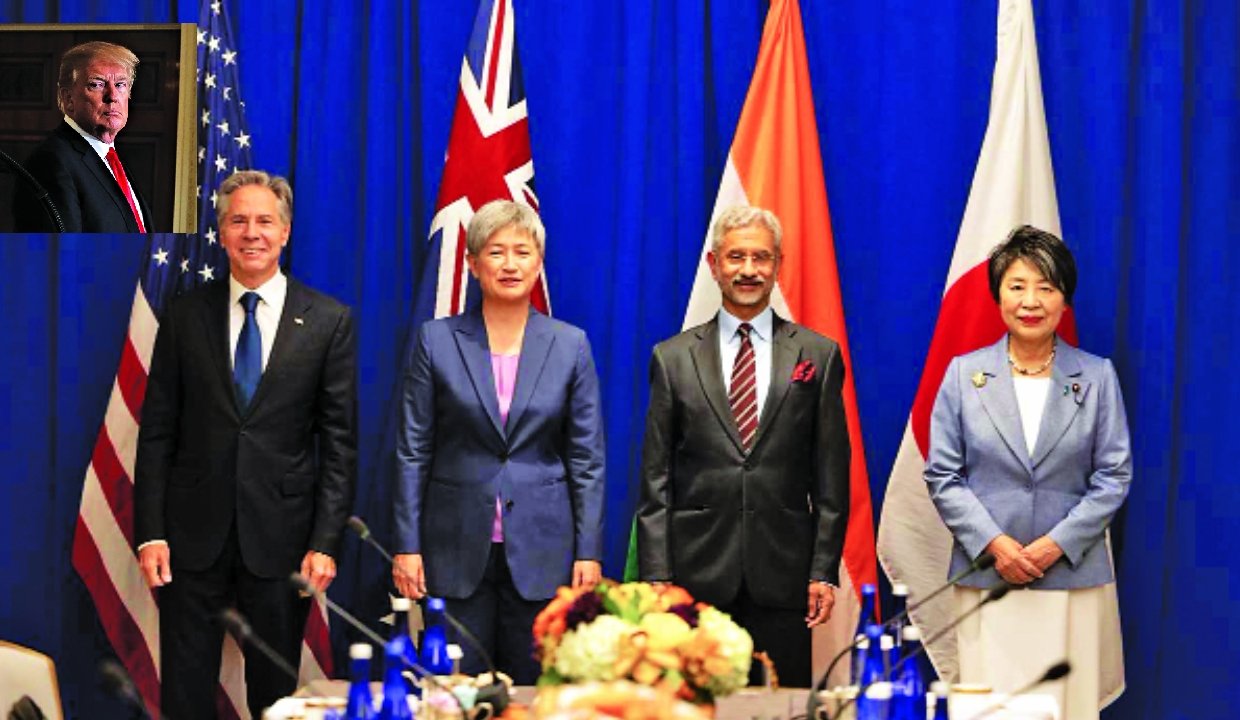
Since his return to the White House in 2025, Trump has refused to participate in a leaders’ summit, negatively impacting the Quad and degrading its geostrategic value
When the Quadrilateral Security Dialogue — commonly known as the Quad — was revived in earnest in 2017, it was hailed as one of the most consequential strategic architectures of the 21st century. A coalition of four like-minded democracies — the United States, India, Japan and Australia — bound by shared values and a common concern about China’s growing assertiveness in the Indo-Pacific, the Quad was meant to be the geopolitical cornerstone of a free and open maritime order. By 2021, it had been elevated to leaders’ summits, producing ambitious agendas on vaccine distribution, climate, critical technologies and maritime security. The euphoria was genuine. The ambition, enormous. The question today is whether that promise has quietly been allowed to slip away.
Under President Donald Trump’s second term, the Quad has not been abandoned outright, but it has been treated with a studied indifference that has done considerable damage. Since his return to the White House in 2025, Trump has refused to participate in a leaders’ summit, leaving the Quad negatively impacted and degrading its geostrategic value. That single fact – the absence of the American President from the high table of the very grouping his own first term helped resurrect — speaks volumes about Washington’s current strategic priorities.
A summit that never was
The most visible casualty of this neglect was the 2025 Quad Leaders’ Summit. The summit was expected to take place in late 2025 with India as the host and President Trump in attendance, but ultimately did not happen, primarily due to heightened tensions between the US and India. Trump’s decision not to attend appears to have had both policy and personal reasons. On the policy side, he demanded that New Delhi agree to a new US-India free trade agreement as a deliverable before his visit.
The consequences rippled far beyond a missed photo opportunity. Trump’s snub was a setback not only for the Modi government but also for the wider partnership committed to a “free and open Indo-Pacific”, with the Quad now risking a loss of momentum. And as if to underscore the perverse priorities at play, Trump chose to visit Beijing rather than New Delhi, sending a message that shook the confidence of all three Quad partners simultaneously.
Tariffs as strategic wrecking balls
Perhaps no single policy has done more damage to the Quad’s internal cohesion than Trump’s sweeping tariff offensive against America’s own allies. Trump imposed a 25 per cent tariff on Indian products, and an additional 25 per cent penalty tariff for India’s purchases of Russian oil. For a partnership built on mutual respect and shared strategic purpose, these were not just trade measures — they were acts of strategic self-harm. Indian exports to the US fell by 37 per cent between May and September 2025, dropping from $8.8 billion to $5.5 billion over that period. A string of unexpected provocations from the White House vaporised New Delhi’s trust in the United States.
Australia fared little better. Australian Trade Minister Don Farrell expressed Canberra’s disappointment at Trump’s imposition of a 10 per cent tariff, even though the United States has a trade surplus with Australia, calling the levy “unjustified”. Japan, meanwhile, faced a 24 per cent tariff on its exports. The irony is galling: the United States was simultaneously demanding strategic alignment from its Quad partners while economically penalising them. Trust, once eroded, does not recover quickly.
The collateral effects were predictable. Indian Prime Minister Modi signed a long raft of new bilateral agreements with Japan, and his defence minister did likewise with Australia — suggesting that the non-US members of the Quad were quietly hedging, building resilience within the grouping independent of Washington. Modi’s conspicuous bonhomie with Xi Jinping at the Shanghai Cooperation Organisation summit, described by Xi as a “Dragon-Elephant Tango”, was a pointed signal of how far Indian strategic patience had been stretched.
The China paradox
Here lies the central paradox of the Trump administration’s approach to the Quad. The grouping exists primarily, albeit tacitly, as a mechanism to balance China’s growing power in the Indo-Pacific. The Quad received only a single passing mention in Trump’s National Security Strategy unveiled in late 2025, a marginalisation that would have been unthinkable two years ago. Beijing has noticed.
China’s assessment of the Quad has evolved from viewing it as a potentially unified anti-China coalition to seeing it as a structurally uneven alignment held together primarily by concern over China rather than by deep internal unity, with Beijing increasingly doubting whether the four countries share the same long-term strategic vision or level of commitment. The redeployment of US forces and warships from the Asia Pacific to the Middle East has further deepened unease within the bloc. When Washington moved troops from Japan to the Middle East, Tokyo saw it as a removal of a direct check on Chinese power at a time when Beijing is conducting large-scale military activity in the region. The Quad’s strategic logic rests on the credibility of American commitment. Every step that erodes that credibility gifts Beijing a strategic dividend.
Rubio’s New Delhi visit: A lifeline or a band-aid?
It was in this context of accumulated mistrust and organisational drift that US Secretary of State Marco Rubio’s recent visit to New Delhi in late May 2026 — the first visit by a sitting Secretary of State after assuming office —assumed outsized importance. The Quad Foreign Ministers’ Meeting on May 26, 2026, did produce tangible outcomes, and Rubio’s tone was notably constructive. He was emphatic that the Quad must evolve from what he termed a “talk shop” into a genuine “partnership of action”.
On maritime security, the most immediate strategic frontier, the announcements were substantive. Rubio announced the launch of the Indo-Pacific Maritime Surveillance Cooperation Initiative, which will leverage each Quad country’s maritime surveillance capabilities in the Indo-Pacific to enhance information sharing, and the expansion of the Indo-Pacific Maritime Domain Awareness Initiative, which provides near-real-time commercial maritime domain awareness data to countries throughout the Indo-Pacific. Rubio also confirmed that India would host the next edition of the Quad at Sea mission, a joint coast guard exercise aimed at improving maritime coordination among partner nations.
The coast guard dimension is particularly significant. India agreed to host the next iteration of the Quad-at-Sea Mission, which brings together coast guards from all four nations aboard a single vessel. This is a deliberate effort to give the Quad a non-militarised, practical face. The Indo-Pacific Maritime Surveillance Collaboration was described not as the militarisation of the Quad, but as a practical effort to share commercially available but expensive surveillance technologies with Indo-Pacific countries that currently lack access to them. Other outcomes included a Quad Critical Minerals Initiative Framework and a joint statement on Indo-Pacific energy security — all areas where practical cooperation can yield real regional dividends.
Will it be enough?
The honest answer is: not by itself. The ministerial-level meeting and the maritime initiatives are welcome, even necessary. But they cannot substitute for leadership-level political will from Washington. The lack of a leaders’ summit under the second Trump administration, and lingering challenges in the relationship between the US and Indian governments, has left many observers uncertain about the future of the Quad in a new era of geopolitical upheaval.
It was resurrected in 2017 precisely because the threat environment demanded it. This time around, the primary reason for potential decline would be more worrisome: Washington may no longer be a reliable strategic partner in the international system. That is a categorically different problem from the hesitancy of 2008. An alliance weakened by external pressure can be rebuilt; one hollowed out by the unreliability of its anchor power faces a more fundamental crisis of purpose. The Quad’s three non-American members — India, Japan and Australia – have shown remarkable resilience, deepening bilateral ties among themselves and continuing to invest in the grouping even as Washington has been distracted. The Quad countries collectively account for about one-third of global GDP and nearly two billion people — a coalition with enormous latent potential. But potential, without the sustained political will of the world’s foremost military and economic power, remains frustratingly latent.
The path forward
The Rubio visit and the New Delhi ministerial meeting have bought the Quad time. The maritime surveillance initiative is the right kind of practical, non-provocative cooperation that builds habits of interoperability and trust. The coast guard mission, in particular, signals that the Quad can operate meaningfully below the threshold of military confrontation — precisely the grey zone where China has been most active. But the Quad’s partners need more. They need a leaders’ summit. They need a US administration that does not treat tariffs on its own strategic partners as an acceptable instrument of coercion. They need Washington to consistently signal that its commitment to a free and open Indo-Pacific is not contingent on trade concessions or domestic political calculus.
The window is not yet closed. The four Quad nations remain united by a common vision for a free and open Indo-Pacific, underpinned by robust economic and energy systems. That vision is genuine and shared. What is missing — conspicuously, dangerously — is the American President’s willingness to show up for it. Maritime surveillance initiatives and coast guard exercises matter. But in the final analysis, alliances are sustained not by technocratic deliverables alone, but by the signal they send to rivals and partners alike: that the great democracies of the Indo-Pacific stand together, at every level, and mean it.
The Quad is not yet dead. But it is being tested in ways its architects never anticipated — not by the adversaries, but by the indifference of its indispensable partner.

