


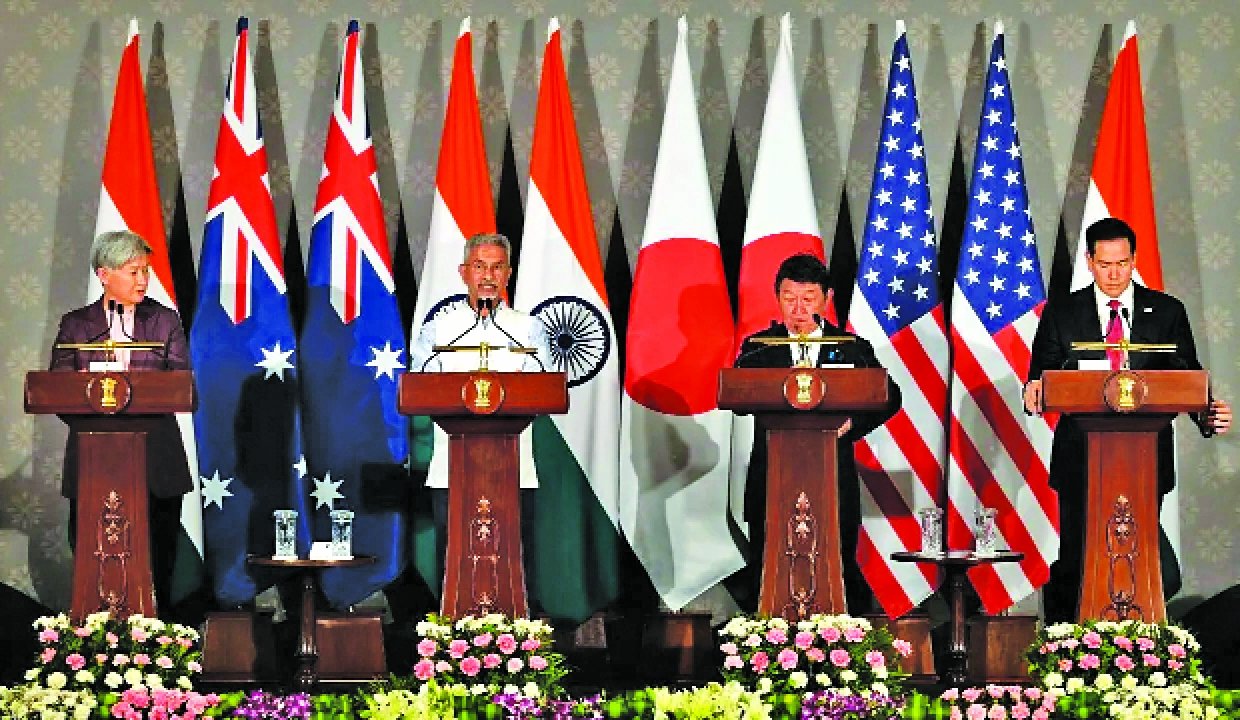
Pentagon officials have been swift to reassure New Delhi that the command’s geographic boundaries and force allocations remain technically unchanged
When the United States Department of Defence quietly announced the reversion of its largest combatant command from U.S. Indo-Pacific Command (USINDOPACOM) back to U.S. Pacific Command (USPACOM), on the eve of the multilateral G7 summit, it framed the change as administrative housekeeping – a tribute to the command’s heritage dating to 1947. Few in Washington’s diplomatic circles bought that explanation. Fewer still in New Delhi.
The deletion of a single prefix – “Indo” – unravels nearly a decade of carefully constructed strategic signalling. When the Trump administration inserted that word in 2018, it was a deliberate geopolitical act, stitching together two oceans into one theatre and formally positioning India as a central pillar of American grand strategy. The Biden and early Trump years built upon that architecture. The 2026 reversion dismantles it. This is not bureaucratic tidying. It is a recalibration of American priorities – and India must read it as such.
From a grand strategic vision, the focus has been reduced to a tactical level.
The “Indo-Pacific” concept was born of ambition. It was designed to dissolve the artificial boundary between East and South Asia, draw India into a unified strategic matrix, and signal to Beijing that the entire arc from the Persian Gulf to the Pacific was under coordinated American attention. It was, at its core, an exercise in expansive geopolitical engineering.
That era is over. The contemporary security environment has forced Washington into hard choices. With finite military resources stretched across Eastern Europe, the Middle East, and East Asia simultaneously, the Pentagon can no longer sustain the pretence of uniform strategic engagement across such an enormous canvas. By reverting to Pacific Command, Washington is making a pointed admission: the acute military challenge from China is concentrated not across the vast Indian Ocean, but in the tight geography of the Western Pacific – the Taiwan Strait, the South China Sea, the First Island Chain.
This is a shift from geographic breadth to operational precision. American command structures, logistics chains, and deployment doctrines are being optimised for one scenario above all others – a high-intensity conflict with China in the Pacific, fought alongside formal treaty allies Japan and the Philippines. The Indian Ocean, and by extension India, falls outside that primary frame.
There seems to be bilateral friction beneath the surface. However, Pentagon officials have been swift to reassure New Delhi that the command’s geographic boundaries and force allocations remain technically unchanged. These assurances deserve scrutiny. The timing and manner of the announcement – dropped on the eve of key multilateral engagements of the G7 – suggest that Washington is comfortable sending an uncomfortable message.
The India-U.S. relationship has been drifting into more transactional territory for some time. India’s refusal to condemn Russia’s actions in Ukraine, its continued economic engagement with sanctioned states, and persistent disputes over trade and tariffs have quietly cooled what was once described as the “defining partnership of the 21st century.” The rebrand does not cause this friction – but it mirrors it. When Washington decides to excise “Indo” from its most consequential military command without prior bilateral consultation, it signals that New Delhi’s symbolic centrality to American strategy has limits.
Nowhere is the structural consequence of this shift more visible than in the Quadrilateral Security Dialogue. The Quad – comprising the U.S., India, Japan, and Australia – was positioned as the premier framework for maintaining a “free and open Indo-Pacific.” That framing now looks increasingly hollow.
The Quad’s core vulnerability has always been its internal contradictions. Japan and Australia are formal U.S. treaty allies with high military interoperability and shared threat perceptions. India is neither. New Delhi has consistently and correctly resisted transforming the Quad into a hard military alliance or an “Asian NATO.” India’s security calculus remains predominantly land-based – shaped by volatile borders with both Pakistan and China – while its Quad partners view the challenge through a maritime, expeditionary lens.
Washington has drawn its own conclusions. The rapid maturation of AUKUS – the trilateral submarine and technology-sharing pact between the U.S., UK, and Australia – and the deepening institutionalization of the U.S.-Japan-South Korea trilateral alliance reveal where American strategic investment is actually flowing. These are tight, legally binding, technologically integrated arrangements built for hard deterrence. The Quad, by comparison, has gradually pivoted toward softer functional cooperation: vaccine delivery, climate technology, and infrastructure financing. Useful, but strategically peripheral. The security architecture of the Quad has been quietly hollowed out, and the USPACOM reversion makes that hollowing official.
For New Delhi, the retirement of the Indo-Pacific command title is a moment of strategic clarification – uncomfortable, but ultimately useful. Three implications stand out.
The most direct operational signal from Washington is that the U.S. expects India to serve as the primary, self-sufficient security provider across the Indian Ocean Region. American forces are anchoring westward in the Pacific. The maritime corridors stretching from the Bab-el-Mandeb to the Malacca Strait – critical for global energy flows and Indian trade – will increasingly be India’s responsibility to secure. This demands urgent acceleration of naval modernisation, expanded maritime domain awareness, and a credible net-security-provider posture across the arc of littoral states in India’s neighbourhood.
India’s long-standing doctrine of strategic autonomy – often criticsed in Washington as fence-sitting – looks considerably wiser in hindsight. If the United States can unilaterally reshape its strategic geographic definitions based on shifting domestic priorities, then India’s insistence on keeping its options diversified is entirely justified. A country that had subordinated its foreign policy to the Indo-Pacific framework would now find itself structurally exposed. New Delhi’s investments in relationships with the Global South, its engagement with middle powers, and its refusal to be locked into exclusive alignments are not liabilities – they are insurance.
The most sobering implication concerns India’s northern borders. The notion that India’s maritime partnership with the West could generate effective leverage against Chinese pressure along the Line of Actual Control was always somewhat illusory. The USPACOM reversion strips away what remained of that illusion. Washington’s hyper-focus on the Pacific theatre means that India’s multi-front friction with Beijing – on land, in the Himalayas, and increasingly in the Indian Ocean through China’s expanding naval presence – must be managed through India’s own diplomatic and military tools. This demands a more pragmatic, direct bilateral approach to Beijing: neither naïve accommodation nor performative confrontation, but clear-eyed strategic competition managed at arm’s length.
A More Honest World Order
The transition from USINDOPACOM back to USPACOM closes the chapter on a romanticised vision of seamless Indo-Pacific solidarity and opens a more fragmented, transactional maritime order. Washington has signaled, unmistakably, that its strategic patience and military resources are finite – and that the Pacific comes first.
For India, this is neither a catastrophe nor abandonment. It is, in fact, a clarifying moment that strips away comfortable illusions about shared burdens and automatic American engagement. The challenge now is to translate that clarity into action: faster naval expansion, sharper diplomacy, and a foreign policy anchored in self-reliance rather than the expectation of external guarantees.
The oceans have bifurcated again. India must decide, quickly, what kind of power it intends to be in the one it calls its own.

