


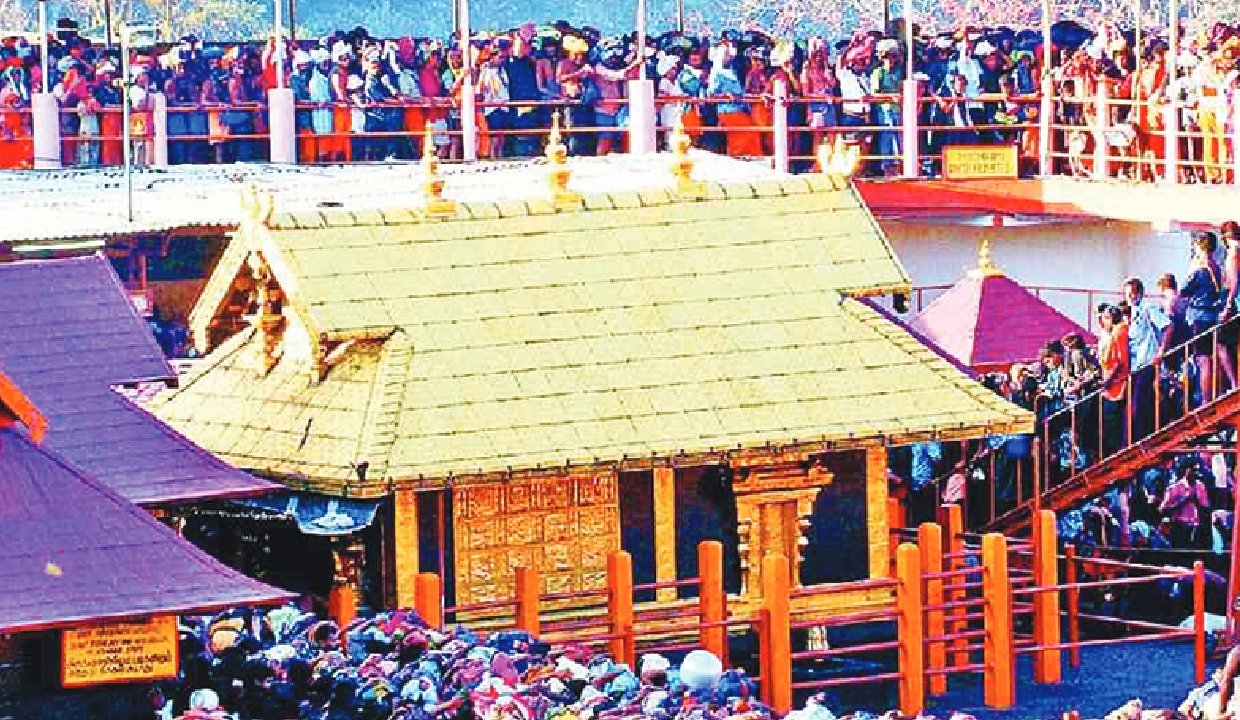
It has been nearly two decades since the Indian Young Lawyers Association filed a Public Interest Litigation (PIL) in the Supreme Court questioning the limitations imposed on the entry of women in the Sabarimala Temple at Periyar Tiger Reserve in Keralam. Since then, a verdict was given by the five-judge constitution bench in 2018, which held that the limited entry of women in the temple was unconstitutional. It was later referred to the bench for a review petition in 2019 and is now set to commence arguments from April 7, 2026, in front of a nine-judge bench of the Supreme Court. This is an extraordinary situation where secular justifications and misogynistic allegations have been used to adjudicate matters which are rooted in religious faith.
The deity at Sabarimala, Lord Ayyappa, is ‘Naisthik Brahamchari’, a lifelong celibate who resides in his abode, the Sabarimala temple. Hence, the women of a given age were restricted from entering the temple. The court case, which had been filed earlier, portrayed the said practice as obscurantist and biased against women in the age group of 10 to 50 years of age. The prejudice towards the biological clock of women was the major bone of contention in the court arguments, while completely ignoring the living faith and nature of tradition at Sabarimala. Travancore Devaswom Board (TDB), which governs the temple, informed that more than 51 lakh devotees, both men and women, visited Sabarimala from 2025-26, thereby generating 429 crore as contributions from devotees. The ‘Memoir of the Survey of the Travancore and Cochin States’, written by British lieutenants, Benjamin Swain Ward and Peter Eyre Conner, published in 1893 and 1901, states their observation of the tradition where more than 15,000 men and women attended the festival but women of a certain age had restrictions. The LDF State Government in 2018 threw its weight behind unrestricted entry of women in the submitted affidavit to the court and the Supreme Court judgement the same year declared the ban on entry of women unconstitutional.
The State Government’s subsequent move to enforce the 2018 verdict met with significant public backlash. Lakhs of devotees were driven to bring the entire state to a standstill in defence of their deity; temple hundis overflew not with offerings but with paper strips inscribed with Ayyappa’s name and the temple priest (Tantri) handed over the temple keys to the state rather than presiding over what was seen as the dishonour of age-old traditions.
Constitutional morality, when it seeks to protect the legitimacy of equality, dignity, and freedom in a legal framework, it is also bound to protect the Hindu deities who are recognised as per law ‘juristic entities’ capable of owning property and paying taxes. The lone dissenting judge in the 2018 Sabarimala judgement, Justice Indu Malhotra, had stated that the belief in a deity, and the form in which it manifests itself, is also a fundamental right protected by Article 25(1) of the Constitution.
A matter of faith is being projected selectively as discriminatory towards women when temples dedicated to women devotees are present within 200 kms of the vicinity of Sabarimala. Attukal Bhagavathy temple in Tiruvananthapuram is devoted to goddess Bhadrakali and allows only women devotees to pray inside during the ten-day Pongal festival. This all-women temple festival holds a Guiness book of world record for the largest congregation of women at a single place. Chakkulathukavu temple in Alappuzha district, every year has ‘Nari Puja’ (worshipping of women) as a tradition where the head priest washes the feet of women as a gesture symbolising the divine status women are bestowed in the Bhartiya culture.
The argument to allow women devotees between the ages of 10 to 50 into Sabarimala takes away the right of Lord Ayyappa to reside in a celibate form in this temple. Even those who take the pilgrimage to Sabarimala, follow the abstinence ritual for 41 days for Lord Ayyappa’s blessings so as to follow the deity’s ascetic yogi avatar in the temple, detaching from material desires, focusing on inner cleansing. It becomes pertinent to note here that the litigants want rights for women to pray to the Lord in a particular temple even though there are hundreds of Lord Ayyappa temples across Keralam where both men and women can pray. The tradition of celebrating the menstruation of goddess at the Shiva Parvaty Chengannur temple in the fourday festival celebrating feminine energy where the goddess is taken in a large procession to the river on an elephant, later received by Shiva at the temple gate where they encircle the temple premises as a couple is a reflection that menstruating women are no taboo in the context of the arguments placed in Sabarimala court case.
The upcoming hearing of the review petition has included cases of other religions like the entry of Muslim women in mosque, the entry of Parsi Women in fire temples after marrying a non-Parsi and the practice of female genital mutilation (FGM) among the Dawoodi Bohra community. Linking of cases which pertain to practices which have entirely different religious tenets with the practice followed in Sabarimala is not appropriate, as the concerns raised about other religious practices are on the dignity to life and discriminatory social traditions largely practised towards women.
For example, in the Hindu belief system, gods and goddesses are acceptable when they take human form and live human lives but the same would be considered blasphemous among Muslims. These cases need to be addressed separately, in the context of whether such practices are considered immoral or contrary to public order or socially harmful. Each and every place of worship has its distinct version of cultural sanctity, which is pivotal to the deity. It is incumbent of the State to give equal rights to all for worship sans interference in their belief to stand as a secular State.
The devotees of Lord Ayyappa stand firmly with the deity, which has compelled the present State Government to dilute its earlier stand of supporting the 2018 Supreme Court judgment regarding the entry of women in the age group 10 to 50 in the temple. Traditions and cultural practices evolve with time but the distinction of social evils from the right of a devotee, character of worship in a religious denomination to connect to the deity reflects on the wisdom and sensibility of the State and judiciary.

